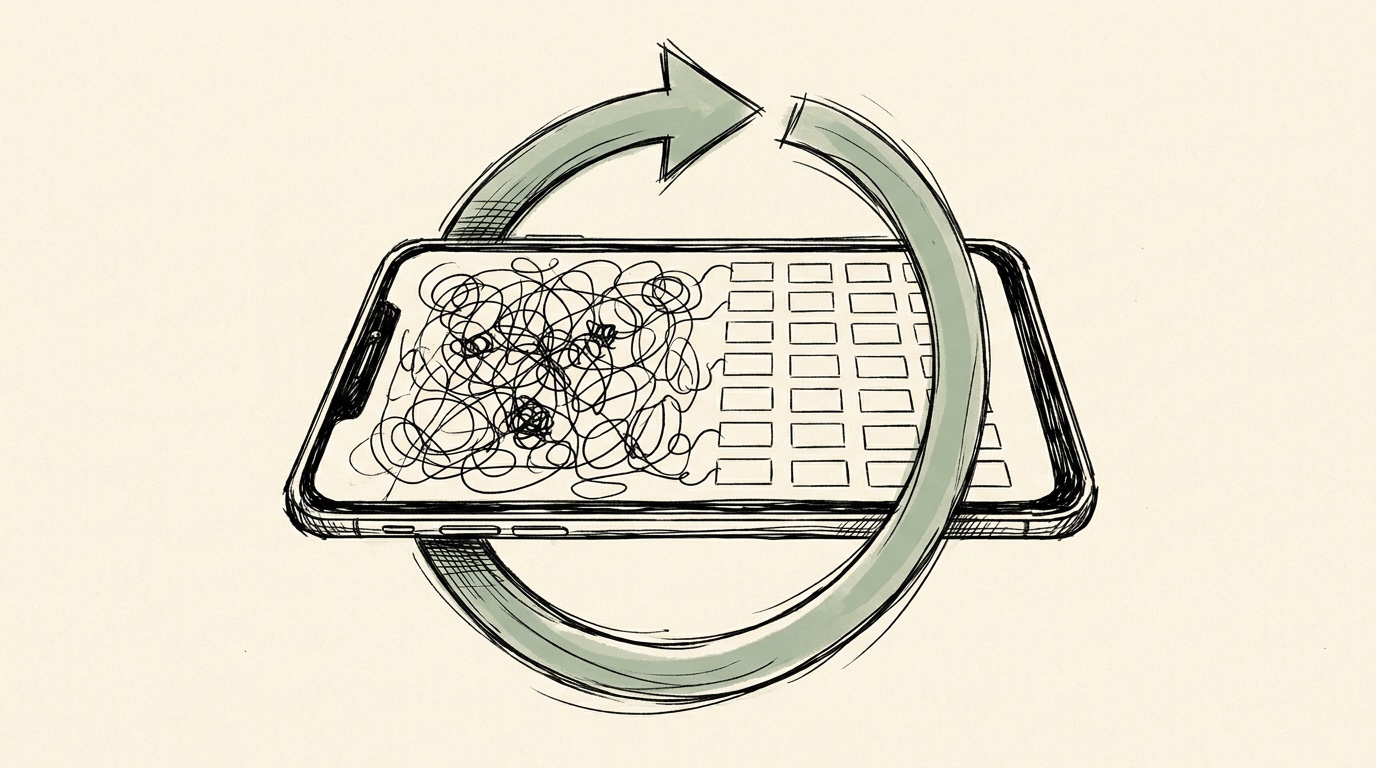
A Social Media Scheduling Tool Is an Execution System
Stop wasting time on manual posting. A social media scheduling tool is your key to reclaiming focus. Learn how to choose and use one for strategic execution.

A social media scheduling tool won't fix a broken strategy. It won't find product-market fit. Its job is to buy back your most valuable asset—time—and enforce the discipline required to build distribution.
Think of it as an execution system, not a solution.
Your Scheduler Is a System, Not a Shortcut
A tool is an amplifier of intent. For a founder, leverage is the only thing that matters. A scheduler is the mechanism for distributing content without getting consumed by low-leverage, repetitive work.
The task is simple: get your message out while you're busy building the product.

Your audience is active when you should be coding or on a sales call. In a saturated digital landscape, consistency is the strongest signal of reliability. Manually posting every day is a tax on your focus. Every minute spent logging in to copy and paste is a minute not spent talking to a customer or shipping a feature.
This is not an efficiency hack. This is a survival mechanism.
The Mindset Shift for Operators
Thinking of a scheduler as a system changes the selection criteria. The question is not, "Which tool has the most features?" It is, "Which tool enforces my workflow and maintains discipline?" The right tool integrates into your operations, it doesn't add a new layer of management overhead.
This system-first thinking prevents common failures:
- Inconsistent Posting: Manual posting is fragile. A system automates consistency, making it antifragile to the chaos of a startup.
- Low-Leverage Work: A founder's time is the most expensive capital. It should not be spent on tasks that can be automated for the price of coffee.
- Strategy Without Execution: A brilliant content strategy is a liability if it remains a document. A scheduler is the bridge between strategy and reality.
A scheduler is often one component in a larger stack of social media content management tools. Understanding its specific role is key.
This mindset transforms any tool, from a basic scheduler to an advanced platform like Hukt AI, into a high-leverage asset. You aren't buying software; you are building a machine.
How Scheduling Tools Actually Work

A social media scheduling tool does one thing: it posts your content at a predetermined time. Everything else is built on that foundation.
For that one job to be useful, a few core functions are non-negotiable. They are what separate a timer from a content system. Without them, you aren't saving time; you're just scheduling chaos.
The Three Functions That Matter
Your content process is an assembly line. To run without friction, it needs three stations. Any serious scheduling tool must provide them.
- Bulk Uploader: This is where you reclaim focus. Instead of context-switching daily to create and post, a bulk uploader allows for batch production. You dedicate a block of time, enter a state of flow, and execute a week or month of content at once. Quality increases when you aren't constantly shifting gears.
- Visual Calendar: This is your command center. Posting content without a macro view is like building a product feature by feature with no roadmap. A visual calendar displays the entire schedule, ensuring your narrative is coherent and aligned with key events like launches. It exposes gaps and prevents your messaging from feeling random.
- Content Queue: This is the engine of consistency. A queue is a library of evergreen content—foundational insights, core brand messages, timeless advice. The tool automatically uses these assets to fill empty slots in your schedule. It is a set-and-forget system that maintains presence even when you are focused elsewhere.
Without bulk uploading, you remain trapped in the daily grind. Without a calendar, your strategy is guesswork. Without a queue, you fail to build a bank of content assets that work for you indefinitely.
With all three, you have a predictable system. You batch creative work, map strategy on the calendar, and let automation handle the monotonous execution. This is how you guarantee content is distributed on time, every time, without consuming your attention.
A good scheduler with this structure is an asset. It imposes discipline and, most importantly, buys back your most finite resource: focus.
Finding Real Leverage in the Machine
Basic scheduling is table stakes. The real leverage isn't found in automating posts; it's found in using the machine to make better decisions.
This is the line between a simple scheduler and a tool built for operators. It's about intelligence, not just volume. I've found three features deliver this level of strategic advantage: data-driven timing, content asset management, and feedback loops.
Data, Not Guesswork, Determines Timing
Forget the generic advice to post on "Tuesday at 10 AM." That is superstition. A smart scheduling tool doesn't guess; it uses your own data. It analyzes when your specific audience has been most engaged historically and recommends optimal posting windows.
First-principle thinking: posting when your audience is already there gives your content the initial velocity it needs to gain traction in the feed.
Turn Your Best Content into a Durable Asset
Content recycling, or the "evergreen" queue, is a fundamental shift in workflow. It turns a successful post from a disposable event into a durable asset. Letting your best content disappear after a single use is a tragic waste of effort. A proper system allows you to categorize top-performing content and automatically re-share it over time.
This provides two critical forms of leverage:
- It reduces creative pressure. You are no longer on a treadmill, forced to generate something new for every single time slot.
- It ensures your best work is seen. New followers and those who missed the initial post are exposed to your most valuable messages.
The primary return on a social media scheduling tool is reclaimed time. Many users recover over seven hours per week. This isn't about avoiding work; it's about reallocating founder-level focus to strategy and growth. The market prices reflect this value—a basic tool might cost 5/month**, while a professional platform with these advanced functions can be **199/month or more. You can explore a breakdown of the best social media scheduler options to see how features align with cost.
Close the Feedback Loop with Analytics
If the tool can't show you what’s working, you're flying blind. Integrated analytics are non-negotiable. You need to know which posts drive conversions, what formats earn engagement, and how the audience is growing.
This data closes the loop between execution and strategy. It tells you where to double down and what to abandon. Without it, you are just throwing content at a wall.
These "advanced" features are not extras. They are what transform a simple scheduler into an engine for insight and operational efficiency.
The Real Cost of Manual Execution
Let's be direct. The decision to use a social media scheduling tool is not about software. It is a capital allocation decision concerning your most valuable resource: founder time. It's a classic build-vs-buy scenario that most founders miscalculate because they only see the monthly subscription fee.
Frame it this way: what is an hour of your focused time worth? If a $20/month tool saves your lean team just two hours a week, the ROI is astronomical. You haven't incurred an expense; you have purchased time to spend on product, sales, or customer discovery.
The Market Signal is Clear
This isn't theory; the numbers show an undeniable trend. The social media management software market is expanding because it solves a real business problem. It grew from 28.58 billion in 2025 to 33.46 billion in 2026—a 17.1% CAGR. Projections show it reaching $62.16 billion by 2030 because 5.2 billion people use these platforms. You can review the raw data in the social media management market report.
This is not about vanity metrics. The sales and marketing segment commanded 37.41% of this market. This confirms that scheduling tools are viewed as revenue-generating infrastructure, enabling awareness and campaigns without massive ad spend. For a startup, this is how you compete.
Automation as Asymmetric Leverage
For any new venture, consistent presence is not optional. It is a signal of life. Radio silence is perceived as decay. The problem is that manual execution is a massive drain on high-value personnel.
A scheduling tool makes consistency economically viable. It systematizes a chaotic, manual process. It eliminates context-switching and low-value labor, allowing one person to operate a content distribution machine that once required a team.
This is how you compete against incumbents. You don't outspend them. You out-execute them by being more intelligent with your resources. Automation is the key to that efficiency.
The bottom line is simple. If a tool gives you back more in time and focus than it costs in dollars, the decision has already been made.
How to Implement an Effective Scheduling Workflow
A social media scheduling tool without a workflow is just another subscription. Buying the tool without building the system is a common failure mode. The power is not in the software; it's in the repeatable process you build around it.
The objective is to transform social media from a reactive, daily task into a managed, predictable system. This requires a shift from last-minute execution to focused, front-loaded work. The principle comes from manufacturing: batching similar tasks reduces waste and improves output quality.
You stop thinking post-by-post and start thinking in production runs.
The Four-Step Execution Playbook
This is not theory. This is the operational playbook for integrating a scheduler and reclaiming your time.
- Content Batching: Block a dedicated window of time—a few hours on a Monday—to create all social content for the upcoming week or two. This is protected creative time. By focusing on a single task type, you achieve a state of flow and produce more coherent, higher-quality work than you could by improvising daily.
- Bulk Uploading: Once created, upload all content into the scheduler at once. Most professional tools support this via CSV or a native interface. This is a mechanical step that should take minutes. It separates creative work from administrative work, preventing the tool from distracting you during the writing phase.
- Calendar Review: With all content loaded, use the calendar view for a high-level strategic check. Does the content tell a coherent story? Are key messages being reinforced? The visual calendar helps you identify gaps, avoid repetition, and ensure your posts function as a campaign, not a series of random thoughts.
- Queue Automation: Finally, populate your evergreen content queues. These are your automated safety net. They fill any gaps in your schedule with proven, high-performing content. This ensures your profiles remain active and consistent, even when your attention is required elsewhere. The system is now running on autopilot.
This diagram shows how these distinct steps create a coherent flow from creation to automation.

The key is that each step is a distinct mode of work. This minimizes the cognitive load of switching between creative, administrative, and strategic thinking. Platforms like Hukt AI are designed around this very principle of intelligent, segmented workflows.
This approach forces you to stop hoping for a magic bullet and instead focus on what matters: creating quality content to feed the system. It builds discipline and transforms a simple scheduler into a powerful engine for your brand.
From Manual to Automated: The Transition Checklist
Migrating to a new workflow is a project. Breaking it down into phases makes it manageable. This checklist provides the steps to move from manual posting to an efficient, automated system.
Scheduler Implementation Checklist for Operators
| Phase | Action Item | Objective (Why it matters) |
|---|---|---|
| 1. Foundation | Choose a scheduling tool with bulk upload & content queues. | The right tool reduces friction. The wrong one adds it. |
| 1. Foundation | Map content pillars and themes for one month. | Provides strategic direction for batch creation. No strategy, no point. |
| 2. Implementation | Schedule your first "Content Batching Day" in your calendar. | Commitment is the first step. Protect this time. |
| 2. Implementation | Create and bulk upload your first week of content. | This is the first "win" and validates the batching model. |
| 3. Optimization | Set up 2-3 evergreen content queues with top-performing posts. | Automation ensures consistency and leverages your best assets. |
| 3. Optimization | Review the visual calendar at the start of each week. | A quick check prevents errors and ensures narrative coherence. |
| 4. Maintenance | Analyze post performance monthly to refine the content strategy. | Data-driven feedback loops improve content quality and impact. |
Following these steps builds a system that not only saves time but also produces more thoughtful, effective marketing. It is a one-time setup for a long-term operational gain.
The Future Is AI Orchestration, Not Automation
Basic schedulers are a commodity. The next frontier is not about queuing posts; it's about intelligent orchestration. This is the difference between giving a tool a set of commands and giving it a high-level objective, then letting the system determine the optimal path to achieve it.

This is not speculation; it is happening now. The best-in-class social media tools are racing to integrate AI-driven scheduling and analytics. Why? Because gaining attention on saturated platforms requires more than a consistent posting cadence. This focus on performance is why the sales and marketing segment is projected to hold 37.41% of the market share.
With the social media management market forecast to reach $171.62 billion by 2033, the capital is flowing toward platforms that deliver measurable results, not just administrative convenience. These social media marketing statistics tell the story.
From Simple Automation to Full Orchestration
What does this look like in practice? Instead of telling your tool, "Post this at 2:00 PM Tuesday," you provide a strategic objective: "Execute a launch campaign for our new feature targeting technical founders and developers."
An orchestration engine, like the one we are building at Hukt AI, takes that high-level goal and executes the entire workflow.
This next-generation social media scheduling tool is designed to:
- Ideate and Create: It brainstorms and generates on-brand copy, posts, and even video scripts tuned for the target audience persona.
- Manage Cross-Channel Campaigns: It coordinates the campaign across key platforms—Meta, Google, LinkedIn—from a single command center.
- Provide Performance Insights: It continuously analyzes what is working and provides clear, actionable recommendations for the next strategic move.
This is about moving beyond filling a content calendar. It is about managing a cohesive marketing presence where AI provides the leverage to scale results without scaling headcount.
It’s the difference between a tool and a partner. One follows instructions; the other helps you win.
Your Questions, Answered: A Founder's Guide to Schedulers
Here are direct answers to the questions we get from founders and operators evaluating a social media scheduling tool.
Will a Scheduling Tool Hurt My Reach?
No. This is a persistent myth. Social media platforms do not penalize accounts for using approved, official third-party APIs.
If your reach declines, the cause is almost certainly the content or the strategy, not the tool. A good scheduling tool should improve reach by enabling you to post better content, more consistently, at optimal times. It is a system for improvement, not a source of penalty.
How Many Platforms Should I Be On?
Fewer than you think. The most common mistake for early-stage companies is attempting to be everywhere. This is a resource trap.
Identify the one or two channels where your audience actually congregates and is receptive to your message. Win there first. A scheduler should help you dominate those core platforms, not stretch your team to mediocrity across ten.
When Is the Right Time to Pay for a Scheduling Tool?
The moment the time you spend on manual posting becomes more valuable than the tool's monthly fee. For most founders, that moment is now.
If a $20/month tool saves you even two hours of focused work, the ROI is self-evident. You are not adding an expense; you are buying back your most valuable asset—time to build your product and talk to customers.
For founders ready to compare options, this guide on The 12 Best Social Media Scheduling Tools for 2025 is a good starting point.
As you scale, remember that a tool handles your company's data and represents your brand. Its security and data practices are an extension of your own. Reviewing a platform's privacy policy is a required step of due diligence. The right tool provides leverage, focus, and peace of mind.
Ready to stop wasting time and start orchestrating your marketing? Join the waitlist for Hukt AI and see how AI can manage your entire campaign lifecycle, from ideation to analytics. https://gethukt.com
About the Author
Founder & CEO of Crowbert Passionate about making enterprise-grade AI marketing accessible to everyone. Building the future of automated marketing, one feature at a time.