Brand Health Tracking: A Practical Guide for 2026
Learn what brand health tracking is, which metrics matter most, how to measure across channels, and how to turn insights into action in 2026.
Your quarterly brand review is tomorrow. The dashboard is full, the survey results are formatted, and every channel manager has a different explanation for what changed. Awareness looks stable, social engagement is uneven, search interest is moving, and nobody can say which signal deserves action first.
That's the operational failure behind many brand programs. Teams collect perception data, channel analytics, and market feedback, then wait for the next reporting cycle before changing the work. Brand health tracking should function as an operating system, not a presentation layer. It should connect what people think, what they do, and what your team changes next.
Table of Contents
What Brand Health Tracking Actually Means in 2026
Brand health tracking is continuous measurement of how a brand is known, understood, considered, preferred, used, and recommended over time. It isn't a one-time survey. Major research providers frame it around repeated measurement of awareness, familiarity, consideration, preference, advocacy, satisfaction, and related perception metrics. YouGov BrandIndex, for example, tracks brand health daily through recurring consumer surveys and reports more than a dozen measures, including advertising awareness, aided awareness, attention, buzz, word-of-mouth exposure, general impression, customer satisfaction, quality, value, corporate reputation, recommendation, purchase intent, consideration, and its overall index. YouGov BrandIndex provides a useful illustration of how a tracker becomes a time series rather than a static score.
The method matters because perception changes as campaigns run, competitors reposition, products disappoint, and market events reshape conversations. A fixed questionnaire, repeated consistently, gives you comparable trend lines. Without that consistency, a score may reflect a change in wording, sample, channel mix, or audience composition rather than a genuine movement in brand health.
In 2026, the operating model is broader than a survey panel. It can combine recurring surveys with social listening, search behavior, owned-channel analytics, CRM or loyalty data, retailer information, customer feedback, and paid media signals. A practical handbook by Surnex is useful background for distinguishing ongoing brand monitoring from broader strategic tracking.
The missing execution layer
Marketing teams have enough data to identify movement. They lack a reliable way to convert that movement into approved work.
A monthly dashboard might show a change in sentiment, share of voice, or engagement quality. The decision may still wait for a quarterly meeting, then move through a creative brief, channel review, approval queue, and publishing calendar. By the time the response appears, the original signal may have changed.
That means your measurement design should include ownership, thresholds, review cadence, and an action path from insight to execution. Your brand voice also needs to be explicit enough for every channel and contributor to apply consistently. Crowbert's guide to what brand voice means is a practical reference for turning positioning into usable rules.
The right question isn't, “What did the dashboard say?” It's, “What should the team approve, change, pause, or investigate because of it?”
The Core Metrics Every Brand Health Tracker Should Cover
A useful tracker follows the customer's movement through the brand funnel. It starts with memory, advances through evaluation, and ends with behavior and advocacy. The six broad categories commonly used in brand-health frameworks are awareness, perceptions, drivers of brand health, Net Promoter Score, satisfaction, and loyalty. A brand health measurement guide groups these measures because they expose both the strength of the brand and the stage where momentum is breaking.
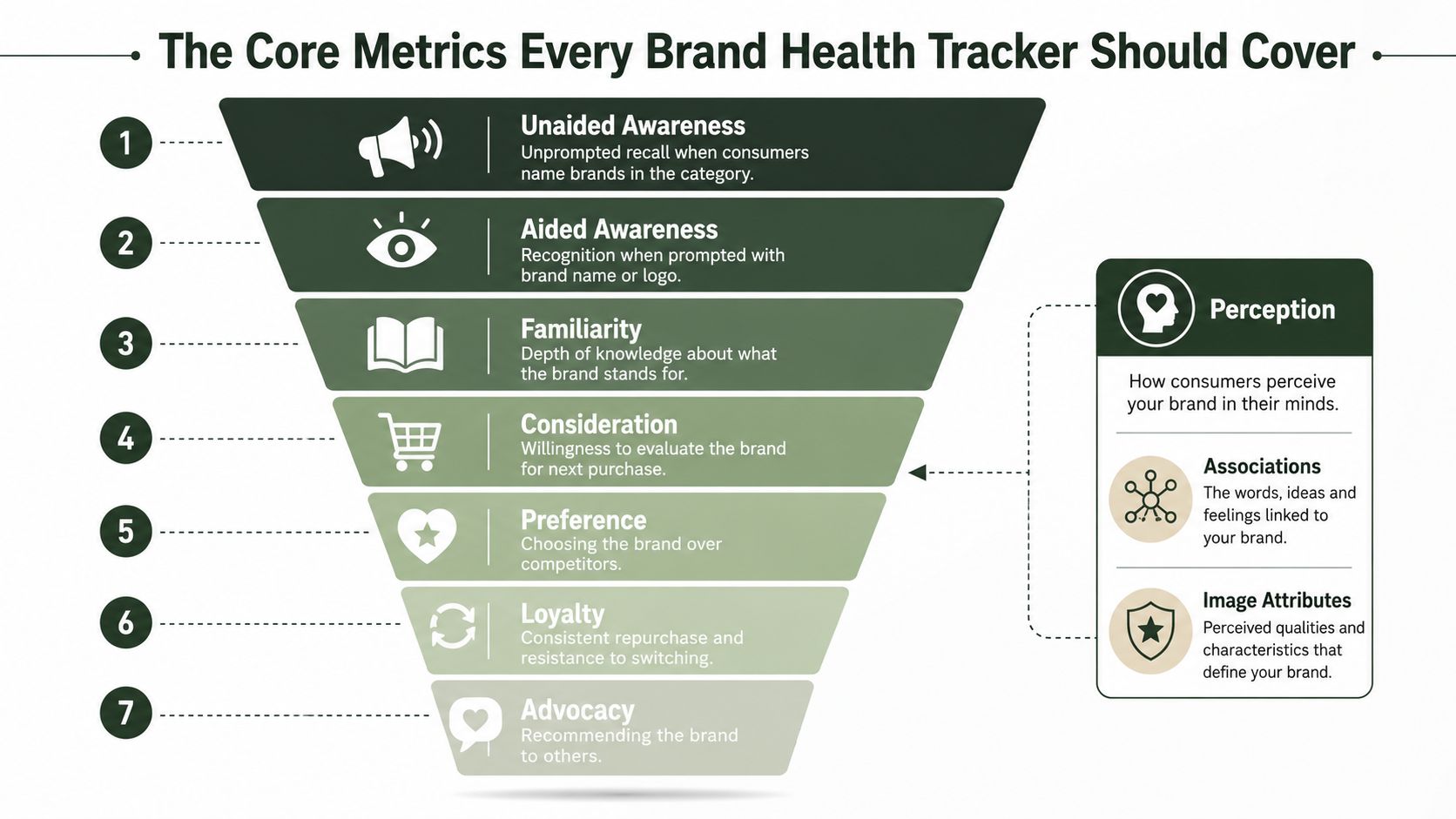
Read the funnel in order
- Unaided awareness asks which brands come to mind without prompts. It captures mental availability, but category leaders can dominate responses while smaller brands remain invisible for reasons unrelated to product quality.
- Aided awareness presents a brand name, logo, or list and measures recognition. It's useful for diagnosing reach, but it can look healthy even when people don't understand the offer or remember it in a buying situation. The distinction between unprompted and prompted awareness is clearly outlined by The Research Agency's brand tracking metrics guide.
- Familiarity measures whether people understand what the brand offers and what it stands for. A respondent may recognize a logo without having enough knowledge to evaluate the brand.
- Consideration captures willingness to include the brand in a future decision. Track it among non-users as well as current customers, because existing users can inflate the score.
- Preference asks whether the brand is chosen over alternatives. It's more demanding than awareness and often reveals whether differentiation is strong enough to influence selection.
- Loyalty reflects continued use, resistance to switching, and repeat behavior. Survey loyalty should be checked against retention or repeat-purchase data, because stated loyalty can mask emerging churn.
- Advocacy measures recommendation and active support. NPS and recommendation questions are common inputs, but advocacy is stronger when paired with referrals, reviews, user-generated content, or voluntary recommendations.
Surfacing metrics with Querio offers useful context on making metric selection more actionable rather than adding more dashboard tiles.
Separate belief from behavior
Perception signals tell you what people associate with the brand, such as quality, value, trust, relevance, or corporate reputation. Behavior signals show whether those beliefs appear in search, site visits, app activity, email response, purchases, repeat use, or community participation.
Use both. Awareness can rise without conversion, and loyalty claims can remain positive while actual usage weakens. Your tracker should preserve the same wording every wave, then connect survey outputs to downstream indicators. Teams can find a practical framework for connecting outcomes to channel activity in this guide to measuring social media success.
Fast signals such as social conversation and channel engagement can change quickly. Awareness, familiarity, consideration, preference, and loyalty usually require more time to establish a durable trend. Don't overreact to one noisy observation, but don't ignore repeated movement because the quarterly score hasn't caught up.
From Quarterly Surveys to Always-On Brand Measurement
The traditional tracker has a clear strength. A fixed survey wave gives you controlled questions, deliberate segmentation, and a direct way to ask why people feel or behave as they do. It also creates a stable reference point for comparing competitors and markets.
Its weakness is timing. Survey collection, cleaning, analysis, and reporting take time, and a quarterly or twice-yearly view can miss a sharp change between waves. Always-on data closes that timing gap, but it introduces noise and usually provides weaker explanations.
| Dimension | Quarterly Survey Tracker | Always-On Multi-Channel |
|---|---|---|
| Primary role | Diagnose awareness, perception, consideration, and loyalty | Detect movement in live market signals |
| Frequency | A defined recurring wave, commonly quarterly | Continuous feeds with weekly operating reviews |
| Diagnostic depth | Strong, because questions can test attributes and reasons | Limited unless combined with surveys or customer feedback |
| Signal quality | Controlled and comparable when wording and sampling remain fixed | Fast but affected by platform changes, volume shifts, and context |
| Best use | Anchor strategic decisions and segment analysis | Flag emerging issues and guide immediate channel checks |
| Main trade-off | More effort per wave and slower feedback | Faster visibility with more interpretation required |
The strongest design is hybrid. Run a core perception wave quarterly, then refresh awareness proxies, sentiment, share of voice, search behavior, and channel signals weekly. A brand tracking funnel framework supports this logic by emphasizing repeated wording, wave-over-wave comparison, behavioral data, and segmentation by market or channel.
Make cadence a decision, not a habit
Quarterly tracking is a sensible anchor for many brands. A major brand-health guide recommends quarterly tracking for unaided recall, with the dashboard refreshed each quarter using new survey data. This quarterly brand health tracking guide describes that cadence as an operating rhythm rather than an occasional audit.
Dynamic categories may need monthly rolling measurement. The choice depends on the cost of being late, the volatility of the market, and how quickly the team can intervene. Don't pay for high-frequency data if your organization can only make quarterly decisions. Conversely, don't accept a slow tracker when a sudden reputation issue can affect customer support, creative, or channel allocation within days.
Your reporting process should make those trade-offs visible. A clear performance reporting framework helps separate executive review from the weekly signal checks that keep the operating system current.
Connecting Brand Health Tracking to Social and Channel Data
Treat each channel as a signal source, not a scorecard. Social platforms can show conversation volume, themes, sentiment, and engagement quality. Search can reveal active interest. Owned channels can show whether attention becomes exploration. Email, community, reviews, and customer support can add context that public posts often lack.
The integration starts with a shared taxonomy. If your survey measures trust, value, quality, convenience, and innovation, social listening and feedback systems should classify conversations against the same attributes. Otherwise, the survey says “value,” the social dashboard says “price,” and the customer-care team says “billing,” even when all three describe the same problem.
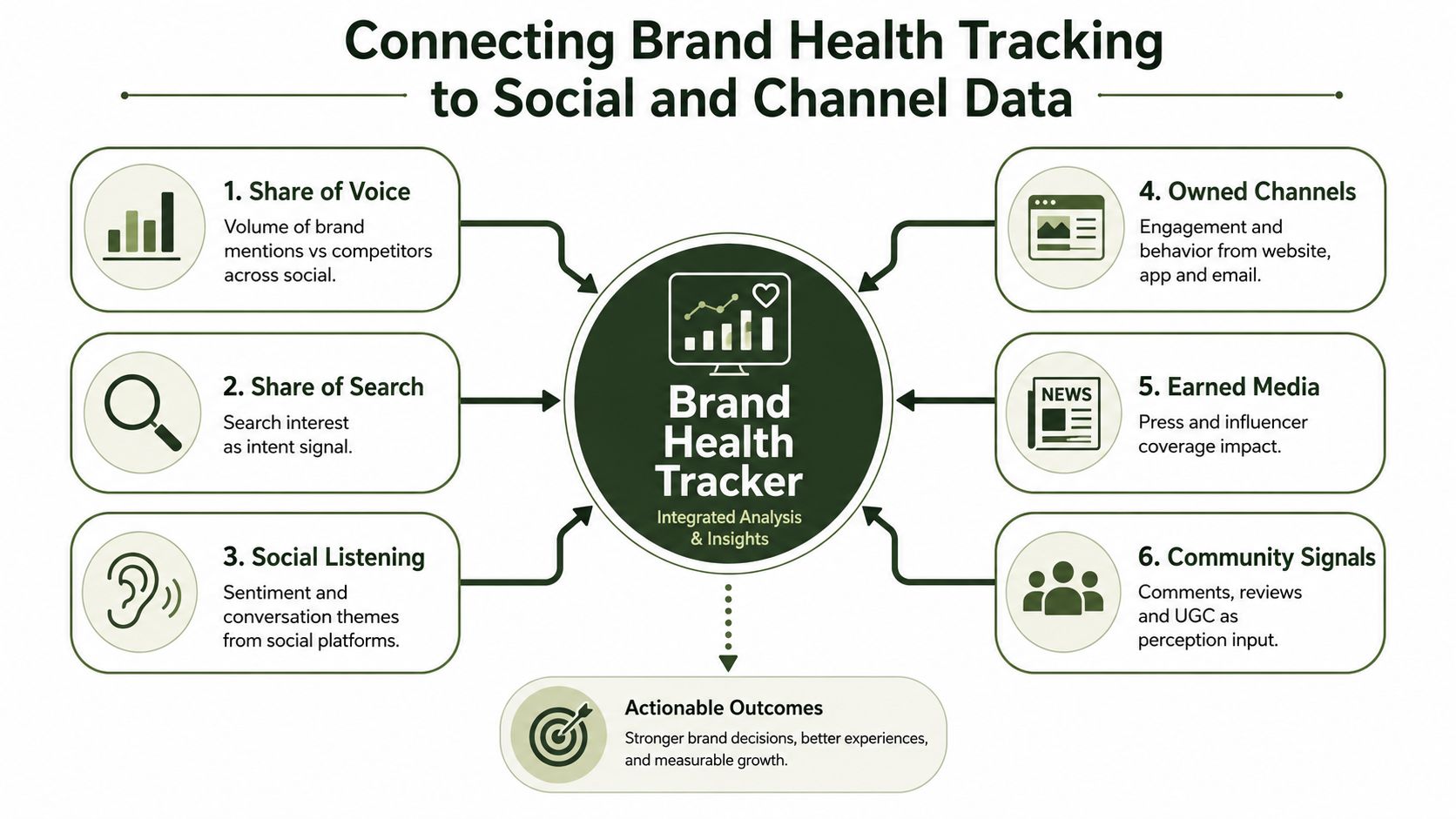
Build the signal map
Start with share of voice, measured against relevant competitors and filtered by topic. A larger mention count isn't automatically healthier if the conversation is negative or unrelated to your positioning.
Add sentiment classification for earned conversations, but review samples manually. Automated classifications can misread sarcasm, product names, slang, and mixed opinions. Sentiment is a directional input, not a substitute for reading the underlying themes.
Then measure engagement quality. Comments, saves, shares, replies, and meaningful questions usually tell you more than raw likes, but each signal needs a channel-specific interpretation. A short video may generate broad attention, while a product announcement may generate fewer interactions but more serious questions.
Map the outputs to funnel stages:
- Awareness: brand mentions, reach, share of voice, search presence, and unaided recall.
- Perception: attribute sentiment, review themes, community language, and survey associations.
- Consideration: branded search behavior, site exploration, product-page activity, email response, and stated intent.
- Loyalty: repeat visits, customer feedback, usage patterns, retention indicators, and recommendation behavior.
Teams evaluating AI search monitoring tools should treat them as one input into this map, not as a replacement for surveys or first-party analytics.
A stable implementation needs consistent identifiers for campaigns, markets, audiences, products, and attributes. Ingest channel data weekly at minimum, then reconcile conflicting signals. Paid social engagement may rise because of targeting or spend while organic brand mentions fall because the underlying conversation weakened. Those are not contradictory once the data is labeled correctly.
For practical monitoring workflows, see what social media monitoring includes. The goal isn't to build a larger dashboard. It's to create one decision-ready view that explains where perception is moving and which channel can influence it.
A Quarterly Brand Health Playbook for Acting on the Signals
Consider a mid-sized consumer brand entering its quarterly review. Unaided awareness is holding, but consideration is slipping. Social conversation has shifted negative around pricing, and a challenger has taken share of voice on TikTok. The team doesn't need another summary. It needs a ranked response.
Start by separating the signal from the explanation. The tracker can show consideration movement. Social listening can reveal pricing language. Channel analytics can show where the challenger is winning attention. Customer support can confirm whether the concern reflects a real experience or a narrow public conversation.
Rank the response
Score each issue against three questions:
- Business impact: Could this affect demand, retention, reputation, or channel efficiency?
- Confidence: Does the same pattern appear across survey, social, search, owned, or customer data?
- Intervention speed: Can the team change the message, creative, channel mix, or service response within the current quarter?
| Signal | Business Impact | Confidence | Action |
|---|---|---|---|
| Consideration slipping while awareness holds | High | High if the movement appears in survey and behavior data | Test clearer value and differentiation messaging |
| Negative conversation around pricing | High | Medium until customer and social themes align | Brief customer experience and pricing teams, then test response creative |
| Challenger gaining TikTok share of voice | Medium to high | High if channel data and listening show the same movement | Rebalance content testing and publishing attention on TikTok |
| Stable awareness | Medium | High | Protect reach while shifting effort toward consideration |
| Mixed engagement quality across channels | Medium | Medium | Review comments, saves, shares, and conversion paths before reallocating budget |
The first move should be creative testing against the perception drift, not a wholesale brand repositioning. Test value framing, proof, use cases, and product explanation. At the same time, rebalance channel activity to recover relevant share of voice rather than chasing every mention.
Create a living review rhythm
The quarterly meeting sets priorities and success measures. A monthly decision meeting reviews whether the intervention is working, while weekly checks watch for new evidence. Assign one owner to each action, define what will count as improvement, and record decisions that the team rejects.
This structure prevents a common failure. Teams notice a problem, commission more analysis, and postpone the intervention until the signal is no longer clear. A tracker should reduce that delay, not formalize it.
How Autonomous AI Agents Change the Brand Health Loop
A dashboard reports movement. An autonomous AI agent can monitor the movement, investigate likely causes, prepare the response, and place the work in an approval queue. That distinction changes brand health tracking from passive observation into an operating loop.
An agent can continuously review tracker outputs and channel signals, flag anomalies, classify emerging themes, draft creative or copy variants, and queue channel-level changes for review. It can also connect a perception issue to the relevant workstream, such as a new content brief, a customer-care escalation, or a revised publishing plan.
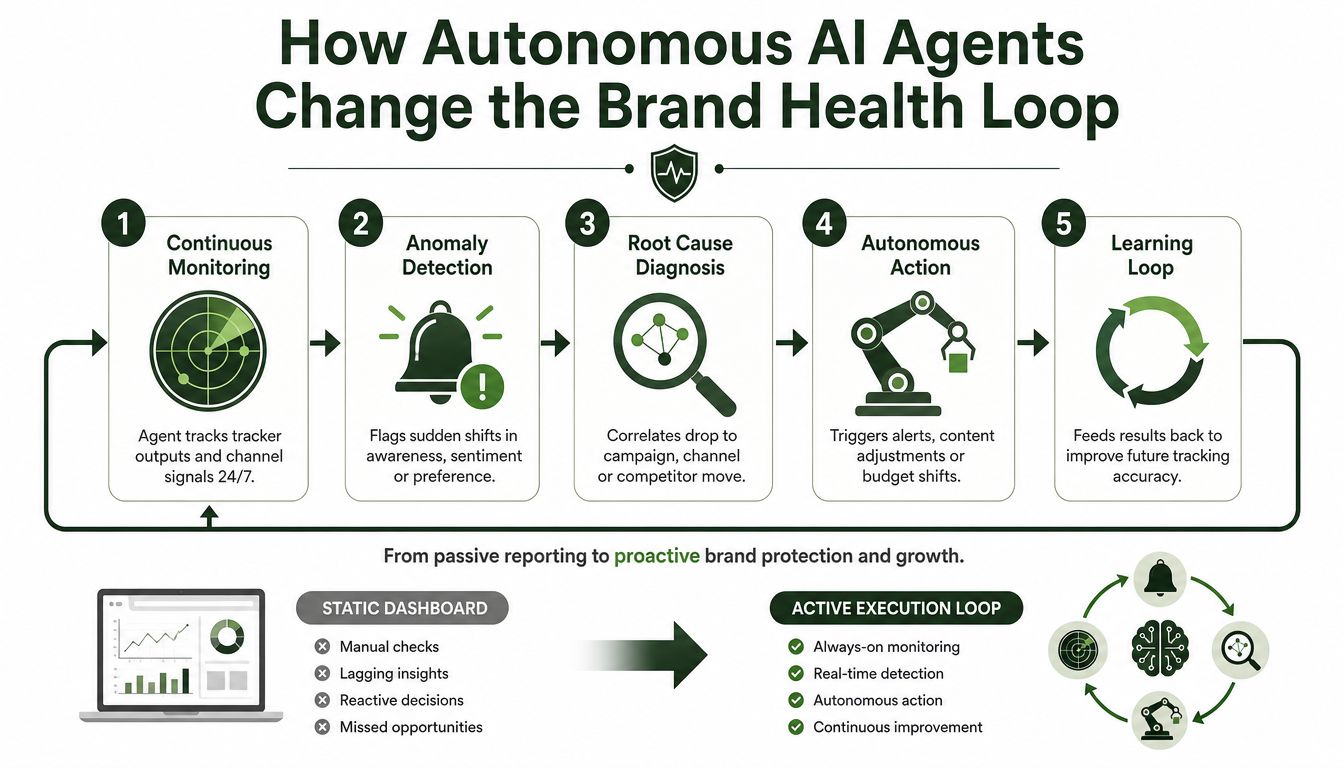
Put boundaries around autonomy
The agent should not have unlimited authority. Brand voice rules, regulated categories, spend caps, legal claims, pricing changes, crisis responses, and sensitive customer communications require human approval. Publishing should remain explicitly controlled, even when drafting, scheduling, and channel adaptation are automated.
That guardrail is also the point of the model. Human reviewers spend less time assembling reports and more time judging whether the proposed response fits the strategy. The loop can move from a long survey cycle to same-day investigation of an emerging perception issue, while the team retains responsibility for material decisions.
Crowbert positions its platform around a dedicated autonomous AI agent that coordinates content creation, channel formatting, scheduling, publishing, engagement workflows, and analytics while keeping human approval in control. Its AI social media management workflow is relevant when the required response involves turning a brand signal into approved, cross-channel social work.
The risks are real. An agent can hallucinate a cause, overreact to noisy data, misclassify sentiment, or produce content that follows a rule mechanically but misses the brand's judgment. Every overruled recommendation should become feedback. Record why the team rejected it, whether the signal was weak, and which guardrail needs adjustment.
The best setup is not “AI decides.” It is AI watches, connects, prepares, and learns, while people approve consequential action.
Frequently Asked Questions About Brand Health Tracking
How often should a mid-sized brand run brand health tracking?
Run a core perception wave quarterly and maintain weekly checks on social, search, owned-channel, and customer signals. Quarterly measurement gives you comparable movement in awareness, consideration, preference, satisfaction, and loyalty. Weekly monitoring catches issues that shouldn't wait for the next survey.
If the category is unusually volatile or the cost of a delayed response is high, use a monthly rolling design. The cadence should match the speed of your decisions, not the reporting preference of your research vendor.
Which single metric should receive priority if the budget is tight?
Prioritize unaided awareness if the brand struggles to enter the category conversation. Prioritize consideration if people know the brand but aren't evaluating it. Choose loyalty or recommendation if the main concern is retention and advocacy.
There isn't one universal winner. The right metric is the weakest important stage in your funnel, validated against behavior. A high awareness score won't compensate for weak consideration, and positive recommendation won't explain a new-user acquisition problem.
Can social listening replace surveys?
No. Social listening is faster and useful for themes, sentiment, share of voice, and emerging issues. It can't reliably represent people who don't post publicly, and it usually can't answer structured questions about familiarity, consideration, preference, or the reasons behind a response.
Use social listening between survey waves. Let surveys anchor the perception model, then use channel and community data to detect movement and investigate context.
How long does it take to see movement in brand metrics?
Fast channel signals can change quickly after a campaign, message, competitor action, or service event. Durable movement in awareness, familiarity, consideration, preference, and loyalty takes longer and should be judged through repeated comparable waves.
Set expectations before launch. Define which indicators are early signals, which are quarterly outcomes, and which require sustained brand investment. Otherwise, the team will demand immediate movement from metrics designed to show accumulated perception.
What data does an autonomous AI agent need before it can act?
Give it a stable brand taxonomy, approved voice and visual rules, channel access, content history, campaign labels, performance analytics, survey outputs, social listening themes, and clear approval permissions. It also needs explicit exclusions for legal, regulated, pricing, crisis, and sensitive customer actions.
Start with recommendations and draft work. Expand autonomy only after reviewers can see why the agent made a recommendation and can feed corrections back into the system.
How do you justify brand health tracking to a CFO?
Connect every tracked metric to a decision. Show how a change in consideration affects creative priorities, how a sentiment issue changes customer-care action, how share of voice informs channel allocation, or how loyalty data affects retention work.
The case isn't that every perception score directly equals revenue. The case is that a consistent tracker reduces decision uncertainty and helps the company allocate marketing, content, service, and media effort against observable movement. Gartner-reported industry coverage says 84% of companies are caught in a “brand doom loop” of undermeasurement and underfunding, a figure cited in NielsenIQ's coverage of traditional brand health tracking. The practical response is to build a measurement system that produces decisions, not another isolated report.
If your brand health data stops at a dashboard, connect it to the work your team can approve and ship. Visit Crowbert to see how an autonomous AI agent can coordinate social content, scheduling, publishing, engagement, and analytics while keeping human approval in control.
About the Author
The team behind Crowbert building AI-powered marketing tools that help businesses of all sizes create professional campaigns, manage social presence, and drive real results.


