Social Media Audit: A Practical 2026 Playbook
Run a social media audit that finds real gaps. Step-by-step framework, KPI benchmarks, checklist, and how to act on findings in 2026.
You're looking at six browser tabs, three analytics dashboards, and a content calendar that no longer resembles the brand you intended to build. Instagram feels polished but disconnected from LinkedIn. TikTok peaked months ago and nobody noticed. The numbers are plentiful, yet no one can answer the important question: which channel deserves more attention next week?
A social media audit should answer that question. It isn't a reporting ritual or a spreadsheet full of likes. It's an operating loop that detects drift, exposes the gap between effort and business outcomes, and forces a decision: keep, cut, rebalance, or reformat.
That discipline matters because social activity now spans multiple discovery surfaces and platforms. Forbes reports 5.79 billion social media users worldwide in 2026, with the typical user active on about 6.5 platforms each month and spending roughly 18 hours and 36 minutes per week on social media. These global usage figures explain why fragmented oversight creates blind spots.
By the end, you'll have a reusable system for monthly check-ins, quarterly reviews, channel-level measurement, and a practical 30-60-90 day execution plan.
Table of Contents
The Moment You Realize Your Channels Are Drifting
The founder opens Instagram first. The grid still carries last quarter's campaign, the bio points to an outdated landing page, and the newest posts use a different tone from the company's LinkedIn page. A TikTok account has a promising archive but hasn't been reviewed since its strongest period. Facebook has an active audience in one group, while the company page receives little attention.
Nothing looks catastrophic in isolation. That's what makes drift difficult to spot. Each channel has its own dashboard, definitions, audience behavior, and publishing rhythm, so a team can spend hours reviewing numbers without producing a decision.
A useful audit performs three jobs:
- Detect channel drift: Find mismatched messaging, stale profile assets, broken links, inconsistent cadence, and unmanaged accounts.
- Expose effort versus outcomes: Compare production time and publishing activity with reach, engagement quality, referral traffic, conversions, and operational risk.
- Force a verdict: Assign every channel, content pattern, and workflow to keep, cut, rebalance, or reformat.
The third job is where most audits fail. Teams often describe what happened, then stop. A better report says, “Keep LinkedIn document posts because they generate qualified conversations,” or, “Reformat short videos because reach is acceptable but watch time collapses early.” It can also say, “Cut this channel for now,” when the account has no owner, no clear audience fit, and no measurable business role.
The business-outcome gap makes this discipline urgent. A 2025 industry survey found that 90% of marketers said social media contributes to revenue, while only 35% said they can clearly prove it. The same survey found 55% prioritize business outcomes, while only 8% still treat click-throughs as the main success signal. The survey figures and broader context support a scorecard built around measurable links among reach, engagement, and conversion, not likes alone.
Your audit should become a decision tool that runs repeatedly. Use a light monthly sweep to catch drift and a full quarterly review to reset priorities. The result is an operating system with named metrics, a checklist, accountable owners, and a 30-60-90 day execution path.
Inventory Every Profile Before You Touch a Metric
Start with governance. An engagement rate from an account nobody can access is not an insight. It's an unresolved operational problem.
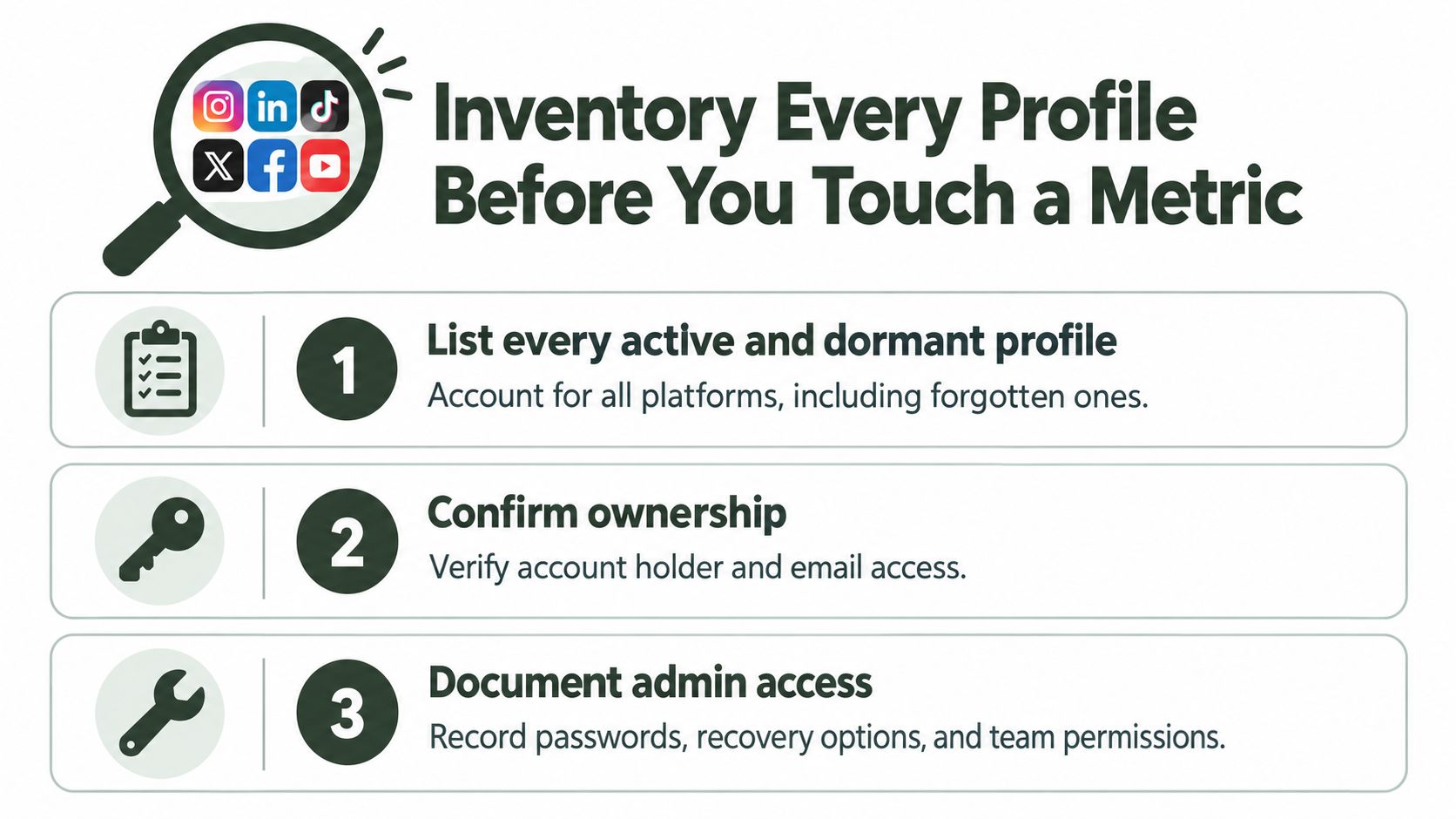
Create one master inventory covering every active and dormant profile on Instagram, LinkedIn, TikTok, X, Facebook, YouTube, Pinterest, Threads, Bluesky, YouTube Shorts, and any niche network your team has used. Record the handle, profile URL, named owner, posting access, advertising access, recovery email, and last login date. Former employees and agencies often leave behind shadow accounts that don't appear in the current content calendar.
Then capture the visible assets:
- Profile identity: Record the bio, profile image, cover image, highlight covers, handle, category, and verification status.
- Conversion path: Test the link-in-bio, pinned post, contact method, booking destination, and any campaign landing page.
- Access controls: Document administrators, editors, approval roles, recovery options, and the process for removing former users.
- Account status: Mark each profile as active, dormant, duplicate, compromised, or ready for retirement.
If you need to collect public profile information for an initial inventory, review a practical resource on an Instagram scraper, while keeping access, privacy, platform rules, and account security under human control.
The ownership rule
Every channel needs a named human owner, a backup owner, and a documented recovery path. Shared passwords and informal access arrangements create avoidable risk. If the owner leaves, the account shouldn't become a stranded asset.
Review how your team handles multiple social media accounts, especially when several people create, approve, publish, moderate, and report on the same channels. The inventory is the source of truth for every later KPI, content, audience, and searchability analysis.
Mark a dormant profile for one of four actions: archive it, merge it, reclaim it, or retire it. Don't let an unmanaged account distort your conclusions about channel performance. A workspace such as Crowbert can keep channel records, content operations, approvals, and reporting in one continuously updated environment instead of forcing the team to rebuild the inventory every quarter.
Channel-Specific KPIs and the Benchmarks That Matter
Blended averages hide problems. A strong average across all channels can conceal weak YouTube thumbnails, poor LinkedIn conversation quality, or a TikTok account that earns views without retaining attention.
Use a channel-specific KPI grid. Define each metric before collecting data, then connect the result to one of the four decisions. Keep when the channel performs its assigned job. Cut when it lacks strategic fit and accountable ownership. Rebalance when the audience or content mix is wrong. Reformat when the idea works but the execution doesn't suit the platform.
| Platform | Primary KPIs to Audit | Healthy Benchmark Range | Audit Verdict Trigger |
|---|---|---|---|
| Engagement rate per post, reach, saves, story completion, follower-to-engagement ratio | Engagement rate per post around 1.1% to 2.5% | Keep strong saves and completion. Reformat when reach exists but retention or saves remain weak. | |
| TikTok | Engagement rate per post, hook retention, average watch time, shares | Engagement rate per post around 4% to 7% | Reformat weak openings. Rebalance topics when shares and watch time diverge. |
| YouTube | Thumbnail CTR, average view duration, returning viewers | CTR around 1.3% to 2.4% | Reformat packaging when impressions don't become clicks. |
| Impression-to-comment rate, follower growth quality, document saves | Use an internal baseline and compare with historical performance | Keep qualified discussion. Rebalance if reach grows without buyer-relevant interaction. | |
| X | Replies as a share of impressions, bookmark rate, profile visits | Use an internal baseline by format and topic | Reformat posts that earn exposure without replies or saves. |
| Page reach, group reach, meaningful comments, referral traffic | Use separate page and group baselines | Rebalance community effort toward the surface with stronger audience response. | |
| Threads | Reply depth, repost-to-like ratio, profile actions | Use a rolling channel baseline | Keep conversations that create secondary discussion. |
The benchmark ranges for Instagram, TikTok, and YouTube come from audit guidance covering channel-specific ranges and review cadence. Treat them as directional context, not universal targets. Your audience, industry, format, and distribution pattern still determine the right interpretation.
Read the metric in context
Engagement rate should be calculated as interactions divided by reach, not followers. That definition matters because reach represents the audience that encountered the content. Track referral traffic from social channels separately, then add conversion rate or ROAS when paid media is involved. This social media audit framework supports treating engagement, referral traffic, and conversion measures as recurring checks rather than one-time observations.
Platform gaps can be dramatic. One 2026 benchmark report cited 27.6% median TikTok engagement in Q4 2025, with twice the median interactions of Instagram and 20 times those of Facebook. Another benchmark placed TikTok at 2.01% engagement, still ahead of Instagram, Facebook, and X. The benchmark report shows why workspace-level averages are unreliable.
Record the definition, date range, source, and verdict beside every KPI. For a detailed framework on interpreting outcomes, use Crowbert's guide to measuring social media success.
Auditing Content Pillars, Creative, and Cadence
Content analysis becomes useful when every post receives a consistent label. Take the last 90 days of posts from each channel, then tag each post to three to five content pillars. Calculate the share of voice for each pillar. Flag any pillar above 50% or below 10%. Those thresholds reveal both overdependence and neglect.
A founder might discover that product education dominates the feed while customer proof appears rarely. Another team may publish mostly promotional content because it's easy to approve, even though educational posts generate more saves and shares. The action isn't automatically to create more of the top-performing pillar. First ask whether that pillar serves the business goal and whether the audience can sustain more of it.
Score the work, not the intention
Grade each post on a 1 to 5 creative rubric covering hook strength, visual clarity, and CTA presence. Keep the scoring simple enough that two reviewers can reach similar conclusions. Don't reward polish for its own sake. A clear, useful post with a specific next step can beat a beautifully produced asset with no point of view.
| Dimension | What to Score | Pass Threshold |
|---|---|---|
| Pillar fit | Whether the post supports a documented strategic theme | Assigned to one clear pillar |
| Hook strength | Whether the opening earns attention quickly | Clear value or tension in the opening |
| Visual clarity | Legibility, composition, format fit, and mobile readability | Message understood without extra explanation |
| CTA presence | Whether the reader knows what to do next | One relevant, specific action |
| Cadence fit | Whether timing and frequency suit the channel | Consistent with the channel's observed audience response |
Use the content pillars framework to make the tagging system operational rather than subjective. Then rank posts by engagement rate and save rate, and inspect the top and bottom quintile. The top group shows repeatable strengths. The bottom group exposes weak hooks, unsuitable formats, unclear CTAs, or topics that don't match audience intent.
Cadence needs the same discipline. Don't impose one uniform weekly target across every network. Compare publishing rhythm with audience activity, production capacity, and the channel's assigned job. If the team can't maintain quality at the current pace, rebalance the calendar before adding more posts.
Audience, Competitive, and Searchability Signals Most Audits Skip
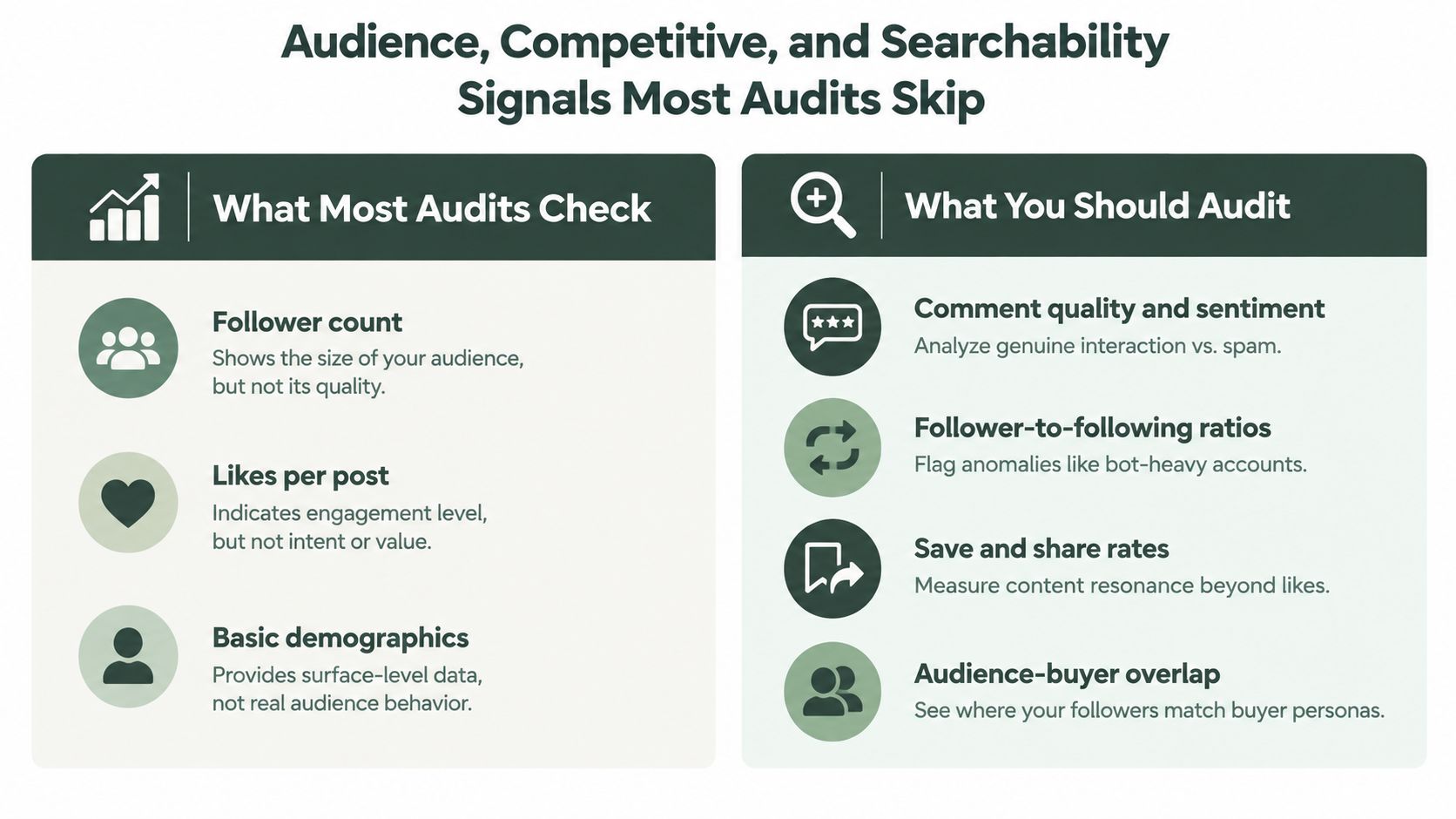
Follower count tells you how many accounts pressed a button. It doesn't tell you whether the people engaging can buy, refer, renew, or influence a purchase.
Review comment quality before comment volume. Separate genuine questions, customer experience, peer discussion, industry conversation, and spam. Compare follower-to-following ratios for anomalies, inspect save and share rates, and map audience overlap against buyer personas. A smaller audience that repeatedly asks relevant questions can be more valuable than a larger audience that never moves beyond passive reactions.
Benchmark the market without copying it
Select a competitor set of five to ten accounts that includes direct alternatives, category leaders, and adjacent brands. Compare posting frequency, pillar mix, hook patterns, format choices, and response behavior. The purpose isn't to imitate. It's to identify a strategic gap, such as a topic nobody owns, a format your team hasn't tested, or a customer question competitors answer poorly.
Searchability deserves its own review. Check whether profile fields contain the language buyers use, whether captions explain the topic clearly, whether alt text describes the asset, and whether pinned content answers high-intent questions. Content can perform well in a feed and still remain difficult to find later.
Social discovery increasingly includes search-like behavior, creator-style formats, and AI-driven discovery surfaces. Review how your brand and key topics appear in tools such as ChatGPT and Perplexity, then compare the language those systems associate with your category against your profile and content vocabulary. Current audit guidance on social searchability and AI discovery makes the point clearly: an audit should ask whether posts are findable, reusable, and structurally optimized, not only whether they performed once.
For a more structured look at audience behavior, use Crowbert's audience insights resource. The output should be a list of profile, content, and discovery fixes, each assigned to keep, cut, rebalance, or reformat.
The Social Media Audit Checklist You Can Actually Use
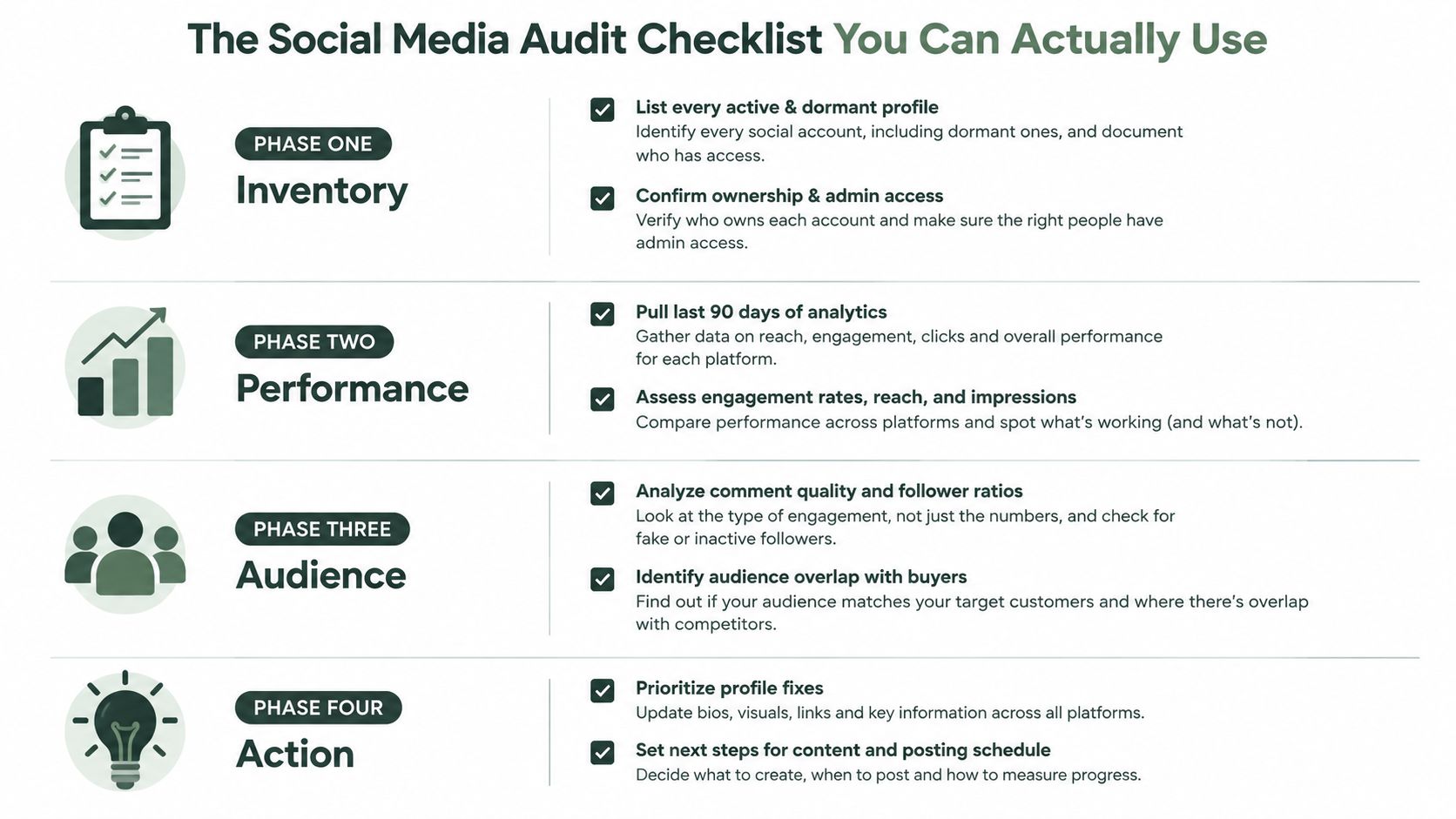
A checklist works when every item has a binary status and an evidence note. “Done” means the team can point to a record, export, screenshot, or approved decision. “Not done” means the item becomes work, not an observation buried in a report.
Phase one inventory
- List every profile: Include active, dormant, duplicate, and forgotten accounts.
- Confirm ownership: Name the primary owner, backup owner, and recovery path.
- Document access: Record publishing, advertising, moderation, and approval permissions.
- Check profile assets: Review handles, bios, links, pinned posts, images, banners, and highlights.
Phase two performance
Pull native analytics for the last 90 days, then complete the channel KPI table. A full audit can use a 12-month data window to capture seasonality and longer-term movement. Record impressions, reach, engagements, CTR, watch time, conversions, and spend, as recommended by this social media audit checklist.
- Separate definitions: Don't blend reach, impressions, engagement rate, CTR, watch time, saves, and conversions into one score.
- Compare baselines: Use historical channel performance and relevant market benchmarks.
- Assign a verdict: Mark every channel keep, cut, rebalance, or reformat.
- Record evidence: Link each decision to an export, report, or documented observation.
Phase three content and creative
Tag the last 90 days of posts by pillar, format, topic, and CTA. Score creative quality, then isolate the top and bottom quintile by engagement rate and save rate.
- Check pillar balance: Flag any pillar above 50% or below 10%.
- Review format fit: Compare native video, carousel, image, document, text, and story performance.
- Inspect cadence: Match publishing rhythm to platform behavior and production capacity.
- Name the change: Keep the strongest pattern, cut waste, rebalance the mix, or reformat the idea.
Phase four audience and search
Review audience quality, buyer overlap, profile keywords, caption structure, alt text, pinned content, and discovery language. Benchmark against three to five competitors for a focused quarterly comparison.
- Assess interaction quality: Separate useful discussion from low-intent or spam activity.
- Test discovery: Search your brand, products, services, and category questions across relevant platforms and AI discovery surfaces.
- Fix conversion paths: Check links, landing pages, contact options, and campaign tracking.
- Assign the next owner: Every fix needs a person and a due date.
Use a monthly light sweep for access, profile changes, core KPIs, and urgent issues. Run the full quarterly review with the broader content, audience, competitive, searchability, governance, and compliance checks. If your brand operates across regions, include a localization audit for global sites so language, landing pages, and regional intent don't undermine otherwise strong social discovery.
Turning Audit Findings Into a 30-60-90 Day Action Plan
An audit becomes operational when each finding has a decision, owner, deadline, and success signal. Don't create a report that asks leadership to interpret the data. Make the recommendation explicit.
The first 30 days
Stabilize the system. Close ownership gaps, correct bios and links, reclaim or retire dormant accounts, establish the KPI definitions, and lock a realistic publishing cadence. If a channel has no clear job or owner, pause expansion until those conditions change.
Days 31 through 60
Rebalance the content system. Adjust pillar coverage, refresh weak creative patterns, improve hooks and CTAs, and adapt each idea to the format of the channel. Tighten profile keywords, caption structures, alt text, pinned posts, and other searchability signals.
Days 61 through 90
Operationalize the loop. Review competitive gaps, test revised formats, document what changed, and schedule the next monthly and quarterly reviews. Your success signal should reflect the channel's job, such as qualified conversations, referral traffic, conversions, watch time, saves, or reduced governance risk.
| Time Horizon | Audit Findings Addressed | Concrete Actions | Owner | Success Signal |
|---|---|---|---|---|
| First 30 days | Unowned accounts, broken profiles, inconsistent definitions, unstable cadence | Assign owners, fix profile assets, document access, retire or pause dead channels, establish KPI baselines | Founder or marketing lead | Every active channel has an owner, recovery path, and defined purpose |
| Days 31 to 60 | Weak pillar balance, poor creative fit, weak hooks, unclear CTAs | Rebalance pillars, refresh templates, reformat proven ideas, improve profile and caption searchability | Content lead and creative owner | Content decisions follow the KPI grid and creative rubric |
| Days 61 to 90 | Competitive gaps, inconsistent reporting, recurring operational drift | Run comparison review, document experiments, automate recurring reports, schedule the next audit cycle | Marketing lead and channel owners | Monthly checks happen on schedule and quarterly findings produce assigned actions |
An autonomous agent workspace can keep this loop from decaying into noise. Crowbert can centralize channel data, content creation, approvals, scheduling, engagement workflows, and performance reporting, while its dedicated agent coordinates specialized work across the social operation. The agent can ingest briefs, flag drift, draft channel-aware fixes, and surface recommendations for explicit human approval. It isn't a monitoring-only layer. It's designed to execute social media work end to end while keeping publishing control with the human team.
For agencies, account ownership and repeatable approvals matter even more. A clear process for managing client accounts keeps audit findings connected to deliverables, owners, and client decisions instead of leaving them in a quarterly presentation.
The practical standard is simple. Every audit should tell you what to keep, what to cut, what to rebalance, and what to reformat. Then it should put those decisions into production.
Crowbert gives your team an autonomous AI agent for social media work across content creation, scheduling, publishing, engagement, analytics, and reporting, with human approval before anything goes live. Turn your next social media audit into an operating loop by visiting Crowbert and reviewing how the workspace can execute the resulting actions.
Frequently Asked Questions
How often should I run a social media audit?
Run a full audit quarterly, with monthly check-ins for core metrics, profile changes, access, cadence, and urgent governance issues. This schedule gives you enough time to identify meaningful patterns without allowing broken workflows or stale accounts to persist.
What metrics matter most in a social media audit?
Start with metrics tied to the channel's job. Review reach, engagement rate calculated from interactions divided by reach, saves, shares, replies, CTR, watch time, referral traffic, conversions, and ROAS for paid activity. Don't treat follower growth or raw reach as a final verdict.
Should I audit dormant social media accounts?
Yes. Include every dormant account in the inventory, then decide whether to archive, merge, reclaim, or retire it. A dormant profile can confuse customers, create brand inconsistency, and remain inaccessible to the current team.
How do I compare performance across different platforms?
Don't use one blended score. Define platform-specific KPIs, compare each channel with its own historical baseline and relevant benchmarks, then assign keep, cut, rebalance, or reformat. A high engagement rate on one network doesn't automatically mean that channel contributes more business value.
Can an AI agent run a social media audit without human oversight?
An AI agent can help collect data, normalize channel definitions, identify drift, draft recommendations, and prepare reports. Human oversight should remain responsible for access decisions, brand-sensitive judgments, compliance, budget changes, and approval of anything that gets published.
About the Author
The team behind Crowbert building AI-powered marketing tools that help businesses of all sizes create professional campaigns, manage social presence, and drive real results.


