AI Social Media Marketing: A Practical Guide for 2026
A practical guide to AI social media marketing in 2026 covering agent architecture, workflows, governance, ROI, and real benchmarks from leading platforms.
At 8:47 a.m., a social media manager is already behind. Six tabs are open, the content calendar drifted out of date last quarter, three drafts are waiting for legal review, the analytics dashboard has refreshed with unfamiliar numbers, and two stakeholders are changing the campaign brief in Slack. Each tool handles one task, but the manager still has to move context between them, check tone, chase approvals, and explain yesterday's results before creating today's work.
That operating model is reaching its limit. AI social media marketing works better when it functions as an end-to-end operating loop, with one shared brand brain coordinating specialized agents for research, creation, scheduling, engagement, and measurement. A human still owns judgment and approval, but no longer has to serve as the integration layer.
Table of Contents
The Daily Reality Marketers Are Trying to Escape
The morning rarely starts with creative work. It starts with reconciliation.
One document contains the approved product language. Another contains the latest campaign brief. A scheduling tool has a different version of the calendar, while the reporting dashboard shows that last week's strongest post came from an angle nobody planned to repeat. Legal has commented on a draft, but the comment lives in a separate approval thread. By the time the manager assembles the context, the useful trend may already have moved on.
The problem isn't that social work contains many tasks. The problem is that those tasks depend on one another, while the systems supporting them usually don't share memory. A researcher identifies a topic, a copywriter rewrites the finding, a scheduler adapts the post to a channel, and an analyst later reports the result. Each handoff introduces another opportunity for a claim, audience insight, or brand rule to disappear.
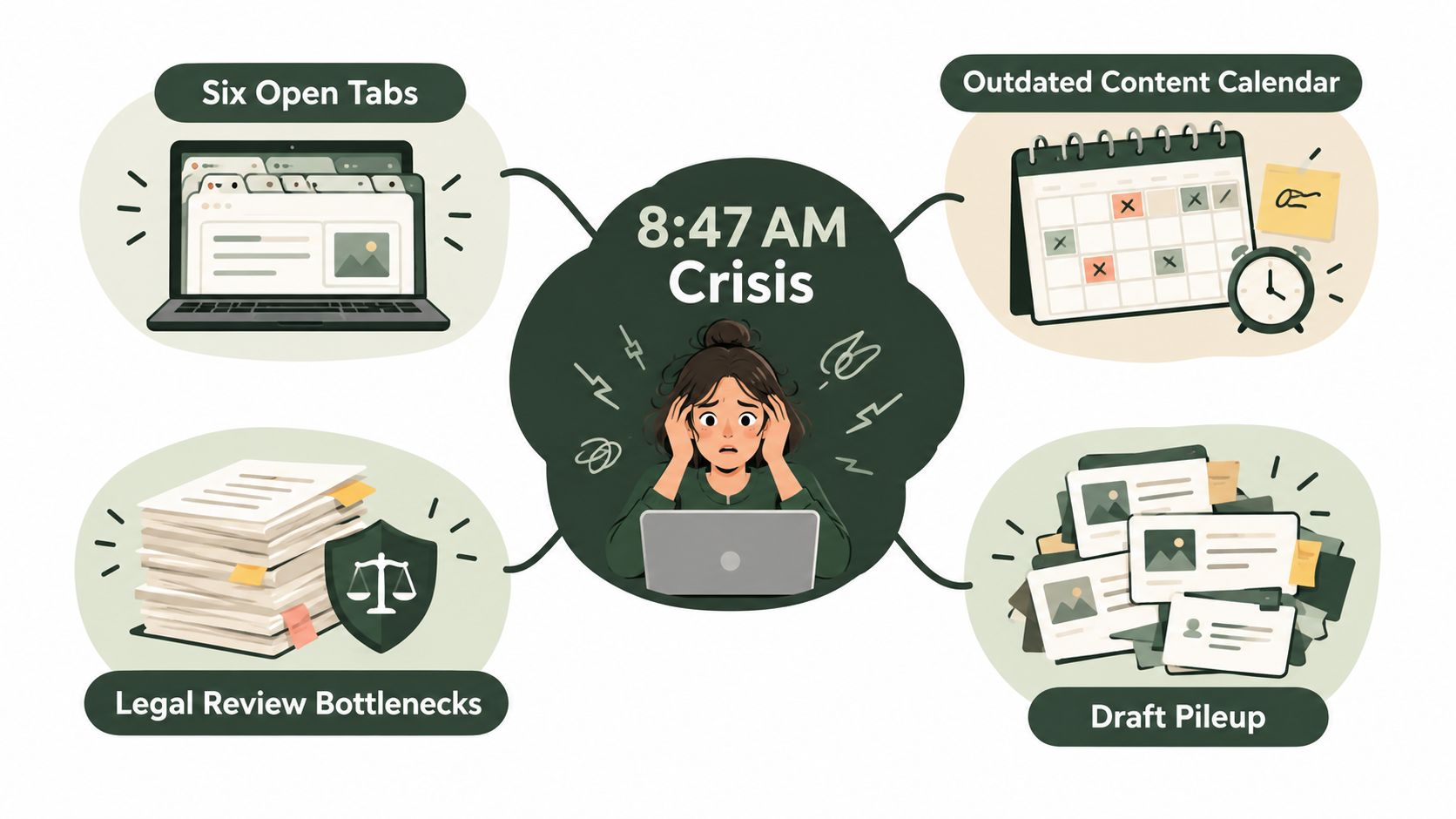
The integration problem
A fragmented workflow creates familiar symptoms:
- Context gets retyped: The same audience, offer, and tone guidance appears in multiple briefs.
- Approvals become invisible work: Reviewers comment on versions that may no longer be the ones scheduled.
- Channel adaptation happens late: A post written for one network gets squeezed into another format.
- Reporting stays disconnected: Performance data arrives after the next brief has already been written.
The platform mix makes this harder. Businesses posted an average of 18.1 times per week on X, 14.2 on Facebook, 9.3 on Instagram, 5.5 on LinkedIn, and 3.7 on TikTok in Q1 2025, according to Hootsuite's platform-specific posting frequency data. Those figures don't prescribe a universal schedule, but they show why channel-aware orchestration matters.
A cleaner model resembles the coordinated approach described in these multi-channel marketing examples. One shared brand brain stores the rules and memory, while specialized agents perform bounded tasks. The manager sets the objective, reviews important decisions, and approves outbound work. The system handles the repetitive movement between stages.
What AI Social Media Marketing Actually Means
AI social media marketing isn't a chatbot with a better caption prompt. Think of it as a junior operating team with shared memory. It can read signals, connect them to a brief, prepare channel-specific work, queue actions, and study the outcome, but it needs a human-defined mandate and clear limits.
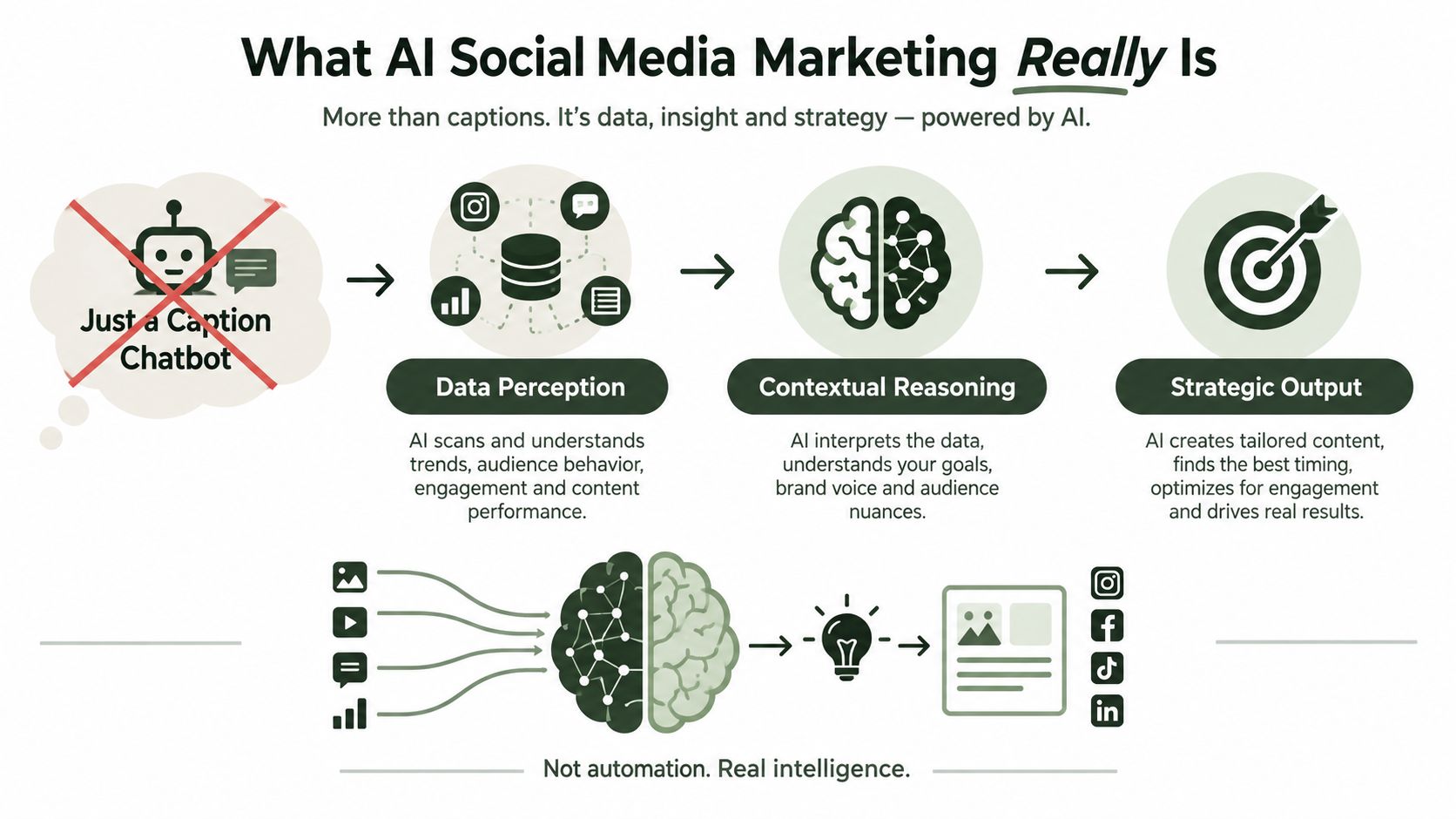
The operating loop has five stages:
- Listen: The system gathers mentions, comments, trend signals, campaign inputs, and approved first-party data. It classifies topics, clusters related conversations, and flags issues that deserve attention. A human decides which signals matter to the brand.
- Ideate: The strategy agent turns those signals into angles, themes, and testable hypotheses. It might identify a recurring customer objection and propose an educational post rather than just suggesting another promotional caption.
- Create: A creative agent produces drafts, images, short videos, and channel variants from the approved brief. A human checks factual accuracy, voice, inclusivity, and whether the idea is worth publishing.
- Distribute: A planning agent adapts formatting, selects a suitable queue, and prepares the approval route. The human checkpoint sits before publication, especially for claims, sensitive topics, and high-reach campaigns.
- Measure: An analytics agent connects the published work to engagement, conversations, traffic, and business outcomes. It turns performance into structured signals for the next brief.
The distinction matters because adoption now spans production and measurement. In 2026, 94% of marketers reported using AI in their workflows, with ideation and brainstorming at 42.9%, caption generation at 41.5%, image generation at 38.35%, and image editing at 34.78%, according to HubSpot's social media marketing reporting. A separate survey found 89.7% of social media marketers use AI daily or several times a week, while 59.5% use it for analytics and reporting in Sociality.io's 2026 report.
That pattern shows why a single-purpose assistant is too narrow. The value appears when creative output, distribution, and analysis inform one another. A practical AI social media assistant should therefore be evaluated by the completeness of its operating loop, not by how quickly it produces a caption.
Agent Architecture Built Around One Brand Brain
A serious system starts with memory, not generation. The brand brain is a persistent, permissioned layer containing voice guidance, approved claims, audience segments, campaign objectives, compliance rules, channel conventions, and relevant performance history. It should retrieve the right context for a task instead of pasting the entire brand manual into every prompt.
Around that memory layer sit agents with narrow responsibilities. Narrow jobs make evaluation easier and reduce the damage caused by an incorrect decision.
The specialist layer
A coordinated setup might include:
- Research agent: Scans relevant conversations and trends, then separates useful audience signals from general noise.
- Creative agent: Converts an approved angle into post drafts, hooks, visual concepts, and channel variants.
- Planner agent: Maps assets to content pillars, campaign dates, platform formats, and available publishing slots.
- Engagement agent: Groups comments and messages by intent, drafts routine replies, and routes sensitive conversations to a person.
- Analytics agent: Explains performance changes, identifies repeatable patterns, and recommends adjustments to future briefs.
Sub-agents handle finer work inside those roles. The creative agent might call a hook-writing sub-agent, a claim-checking sub-agent, and a format adaptation sub-agent. The planner might call a conflict detector to identify overlapping campaigns or a rescheduling specialist to recover from a missed slot. This is more reliable than asking one large prompt to perform every job at once.
The architecture also needs retrieval, evaluation, and control. Retrieval brings approved facts and current campaign context into the task. Evals test whether an output follows tone, format, policy, and factual requirements. Kill switches stop queued actions, disable a risky agent, or prevent a category of content from publishing.
Sandboxing before autonomy
Content should begin in a draft state. Replies should remain drafts or proposed actions, scheduled posts should enter a queue, and publishing credentials should be isolated from research and experimentation. Human approval stays mandatory until the team has evidence that the workflow behaves consistently.
Crowbert describes this model through a coordinated AI agent architecture, with a dedicated workspace and specialized agents working under approval controls. The important design choice isn't the number of agents. It's the separation of duties, shared memory, traceable decisions, and a clear boundary between preparation and publication.
The Four Core Use Cases That Move the Needle
A productive AI social media system connects four jobs in one operating loop. A content agent turns strategy into drafts, a planning agent places approved work into a queue, an engagement agent prepares the response layer, and an analytics agent converts results into the next brief. Each role has a clear handoff and a human approval point.
Content generation
Generation works best when the brief comes first. Give the agent the audience, objective, approved claim, content pillar, channel, desired action, and exclusions. It can then produce several directions without making the marketer repeat the same constraints in every prompt.
The marketer's role changes from typing every sentence to choosing the strongest idea, correcting nuance, checking claims, and adding experience the model does not possess. Most AI-assisted drafts still need a human editing pass before publication. The Sociality.io's survey also reported that 71.1% identified time savings as AI's biggest workflow benefit, which explains the appeal without removing editorial responsibility.
Scheduling
Scheduling becomes useful when it responds to channel behavior and campaign dependencies. The planner can select a queue, prepare network-specific variants, detect conflicts, and reschedule a post after a late approval. Cadence differs by network. Buffer's frequency guide reports a median Facebook frequency of 35 posts per month, alongside recommended ranges of 1 to 2 posts per day on Facebook, 3 to 5 posts per week on Instagram, and 2 to 5 posts per week on TikTok.
These figures are planning references, not fixed targets. The agent still needs the audience, format, team capacity, campaign sequence, and purpose of each post. A frequent publishing schedule cannot compensate for weak briefs or unclear approvals.
Engagement
An engagement agent should classify incoming messages, identify routine questions, draft replies from approved information, and route exceptions to the right person. Complaints, safety concerns, legal issues, and high-value opportunities require escalation rather than an automatic response.
The division of labor is straightforward. The system sorts and prepares. A human supplies empathy, judgment, and context when a generic reply could damage trust. That boundary makes automation more useful because it reserves human attention for conversations where it has the greatest effect.
Analytics
Analytics closes the loop by connecting results to decisions. Rather than producing a dashboard that nobody uses, the agent should explain which topics, formats, hooks, and calls to action deserve another test. It can turn post-level performance into structured recommendations for the next brief.
The Grou pipeline marketing guide provides useful background for connecting social activity with a broader demand process. Publishing is one step in that process. The analytics agent should show how social responses support the next marketing action, not treat reach as the final outcome.
| Use Case | Responsible Agent | Human Approval Point | Typical Lift |
|---|---|---|---|
| Content generation | Creative agent | Select the angle, verify claims, edit the draft | Faster first drafts and more usable variants |
| Scheduling | Planner agent | Approve the queue and exceptions | More consistent, channel-aware execution |
| Engagement | Engagement agent | Approve sensitive replies and escalations | Less manual triage and faster routing |
| Analytics | Analytics agent | Validate recommendations before changing strategy | Shorter distance from results to the next brief |
A social media automation workflow should connect all four jobs. Automating only drafting leaves the approval queue, publishing calendar, and reporting process unchanged. The operating gain appears when evidence from one cycle improves the next cycle under human review.
A Practical Implementation Roadmap
A mid-sized team doesn't need to automate every channel at once. A controlled rollout produces cleaner evidence and gives reviewers time to learn how the system behaves.
Phase one, establish the operating boundary
Inventory channels, brand guidance, recurring campaigns, data sources, and approval owners. Narrow the initial scope to two platforms and three content pillars so the brand brain learns from consistent material rather than contradictory examples.
The go or no-go checkpoint is simple. Proceed only when each pillar has an owner, each channel has an approval path, and the team can identify which claims require subject-matter review.
Phase two, run in shadow mode
Create the specialist agents with sandboxed credentials and read-only analytics access. Let them prepare drafts, proposed schedules, reply classifications, and reports alongside the existing manual process. Run this shadow workflow for two weeks, then compare its outputs with the decisions the team made.
Advance when reviewers can trace why an agent produced an output, identify recurring failure modes, and confirm that no content can publish without an explicit approval.
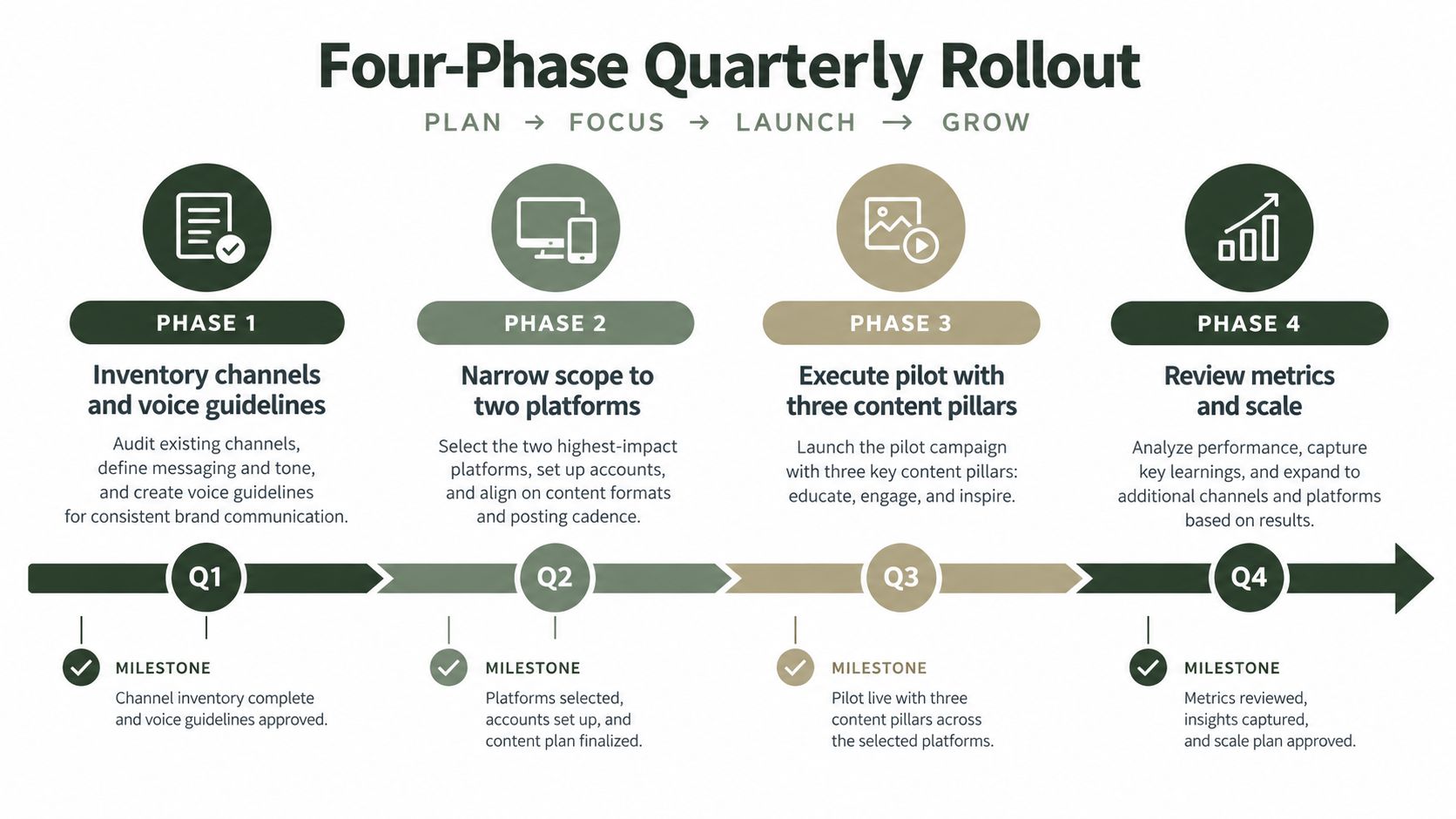
Phase three, activate low-risk work
Turn on scheduled publishing for routine, low-risk posts. Add engagement triage, define escalation rules for negative comments, and keep product claims, policy responses, and crisis content behind a named human reviewer.
The checkpoint is operational rather than technical. The team should know who pauses the queue, who handles an escalation, and how a rejected draft returns to the system without losing its history.
Phase four, move into production carefully
Promote the workflow from shadow to production while retaining human-in-the-loop approval. Hold weekly retrospectives that examine rejected drafts, missed opportunities, rescheduling decisions, and performance signals. Update prompts and retrieval rules from those observations, not from vague preferences.
This video provides a visual overview of a quarterly rollout:
Governance, Authenticity, and Real Risks
Efficiency can hide a credibility problem. Independent research on AI-generated marketing content finds that awareness of AI authorship can reduce perceived authenticity, which can then weaken trust, brand attitudes, and behavioral intent. The research on consumer trust in AI-generated marketing content makes the trade-off clear: production can scale while credibility falls if the output feels synthetic.
Disclosure shouldn't be treated as a universal label applied without context. The right standard depends on the channel, the content type, the audience expectation, and whether a person is represented as speaking directly. A brand should disclose AI assistance when concealment would create a misleading impression, particularly for synthetic people, fabricated experiences, or automated customer conversations.
A practical editorial standard
Use AI to draft, summarize, classify, and triage. Require a named human to approve:
- External claims: Product facts, performance statements, pricing, guarantees, and policy language.
- Crisis responses: Any message involving safety, legal exposure, public criticism, or sensitive events.
- Personal replies: Responses that appear to come from an identifiable employee or executive.
- High-consequence decisions: Content that could affect a customer's account, eligibility, access, or purchase.
The main failure modes are predictable. A model may invent a product detail, a careless prompt change may cause voice drift, and direct posting rights may turn a small error into a public incident. Sandboxed credentials, versioned prompts, approval logs, and kill switches reduce the blast radius.
Incident response
A bad post needs an owner and a same-day process:
- Pause the relevant queue or agent.
- Preserve the draft, approval record, and published version.
- Remove or correct the post according to the incident policy.
- Check related posts, replies, and scheduled variants.
- Identify whether the failure came from retrieval, generation, approval, or publishing.
- Update the rule, test, or permission that allowed it.
Measuring ROI From AI Social Workflows
A defensible ROI story starts before automation. Record the current posting cadence, engagement rate, qualified conversation volume, creator hours, approval time, and pipeline contribution. Without a baseline, time savings and revenue influence become impressions rather than evidence.
Attribution should also match the buying process. Use UTM tags for campaign and content variants, dedicated landing pages for meaningful initiatives, and pipeline-stage weighting instead of relying only on last-click conversion. A post that creates an initial conversation may deserve credit even when another channel receives the final interaction.
Retire metrics that don't guide a decision. Vanity likes can remain visible, but save rate, qualified conversations, branded search lift, assisted conversions, and cost per qualified conversation are more useful operating signals. The reporting layer should explain what changed and what the team will do next.
A social media analytics report becomes more valuable when it connects those signals to hours and revenue rather than listing channel totals.
| Metric | Baseline | With AI Workflow |
|---|---|---|
| Publishing cadence | Record current weekly output by channel | Compare approved output with the planned queue |
| Creator hours | Record hours spent drafting and adapting | Track hours redirected to strategy and review |
| Approval time | Measure time from draft to decision | Measure queue age and time to approved publication |
| Qualified conversations | Count conversations meeting the agreed definition | Compare volume and downstream quality |
| Assisted pipeline | Record attributed pipeline using a documented method | Compare contribution by campaign and content pillar |
| Cost per qualified conversation | Calculate from tracked campaign and labor inputs | Compare after the workflow stabilizes |
The CFO-ready version pairs operational efficiency with commercial contribution. It doesn't claim that every conversion came from AI. It shows which workflow produced the work, which content influenced the journey, what human time it consumed, and where the evidence remains uncertain.
Frequently Asked Questions
How quickly can a mid-sized team deploy an agent-based workflow?
A controlled pilot can fit within a quarter if the team starts with two platforms and three content pillars, uses shadow mode, and assigns approval owners before connecting publishing. Don't expand until reviewers can trace outputs and stop the queue.
Does AI social media marketing still require a community manager?
Yes. AI can classify messages, prepare routine replies, and identify escalation triggers, but a human should own empathy, judgment, crisis communication, and conversations involving policy or personal circumstances.
Which platform integrations should a buyer prioritize?
Choose channels with stable publishing, analytics, and engagement access, then match the choice to your actual audience and approval process. A broad integration list matters less than reliable permissions, clear logs, channel-aware formatting, and safe rescheduling.
How should teams budget inference costs against labor savings?
Track AI usage, review time, production hours, approval time, and qualified business outcomes separately. Compare the total workflow cost with the hours and pipeline influenced, rather than treating the model bill as the only cost.
What disclosure standard should govern AI-assisted content?
Disclose AI involvement when hiding it could mislead the audience, especially for synthetic identities, automated customer conversations, fabricated experiences, or content making consequential claims. Keep a named human accountable for every externally published claim and crisis response.
Crowbert provides a dedicated autonomous AI agent that coordinates content creation, scheduling, publishing, engagement, and analytics while keeping human approval in control. Visit Crowbert to evaluate whether an end-to-end agent workflow fits your channels, approval process, and reporting requirements.
About the Author
The team behind Crowbert building AI-powered marketing tools that help businesses of all sizes create professional campaigns, manage social presence, and drive real results.