How to Improve Social Media Engagement in 2026
Learn how to improve social media engagement with channel-specific benchmarks, timing strategies, and AI workflows that drive measurable growth.
The most popular advice about social media engagement is also the least useful: post more and chase likes. That approach treats every network as if it rewards the same behavior, then asks teams to explain why a post succeeds on one channel and stalls on another.
A stronger approach treats engagement as a distribution system. Shares, saves, comments, watch time, direct messages, and meaningful replies tell you more about content value than follower growth or passive approval. The work is to match those signals to each platform, publish at a sustainable cadence, respond while conversations are active, and measure performance using a consistent denominator.
Table of Contents
Redefining Engagement Beyond Vanity Metrics
Likes still have a place in reporting, but they shouldn't be the headline metric for every campaign. A like is a low-effort acknowledgment. A save suggests future utility, a share places the content in front of a new audience, and a direct message creates a private conversation that may reveal intent, confusion, or purchase interest.
That distinction changes how you plan content. A practical social media KPI framework should separate exposure, interaction, redistribution, and business action. Reach tells you how many people had an opportunity to see a post. Engagement tells you whether they did something with it. Neither metric explains performance on its own.
Measure the action you want
Start with one primary engagement objective for each content idea:
- Redistribution: Build posts that people can forward, repost, or share with a colleague.
- Retention: Use concise video structures, useful carousels, and clear sequencing that encourage people to keep watching or save the post.
- Conversation: Ask a specific question that makes a thoughtful response easier than a generic “What do you think?”
- Intent: Treat clicks, profile visits, and DMs as evidence that the audience wants a next step.
The denominator matters just as much as the numerator. Engagement rate may be calculated using followers, reach, impressions, or views, and the result changes with that choice, as explained in Hootsuite's engagement rate methodology. Use follower-based measurement for account-level comparisons over time, reach for post-level organic analysis, and impressions or views when those are the most relevant distribution measures.
Platform norms vary sharply. A post with a modest reaction count can still be strong if it generates saves or shares relative to the people who saw it. Conversely, a post with many likes may contribute little to redistribution or qualified conversation. For X-specific publishing behavior, the guide to threads and timing on X offers useful context on how sequence and timing affect participation.
The first step in how to improve social media engagement is therefore diagnostic, not creative. Define the action that matters, record the formula used, and compare the post with the correct network-specific baseline.
Aligning Content Formats With Platform Benchmarks
A universal engagement target creates bad decisions. Teams often move a successful format from one channel to another without adapting its structure, then blame the creative when the audience responds differently. The 2026 benchmark data makes the problem clear.
Buffer's analysis of 350,000+ accounts reported the following median engagement rates across six major networks. The same dataset identified native formats that aligned with the strongest median results on each platform. Review the calculation method before comparing rates, because follower, reach, impression, and view denominators aren't interchangeable.
| Platform | Median Engagement Rate | Top Performing Format |
|---|---|---|
| 6.2% | Carousels | |
| 5.6% | Picture posts | |
| 5.5% | Reels | |
| TikTok | 4.6% | Video |
| 4.0% | Platform-native visual content | |
| Threads | 3.6% | Conversation-led posts |
| X | 2.5% | Text posts |
These numbers aren't universal targets. They describe the distribution environment captured by that benchmark and show why one scorecard can mislead. Another 2026 benchmark set reported TikTok at 4.25% and X at 1.11% across 350,000+ analyzed accounts, reinforcing the need to inspect methodology before drawing conclusions.
Match the idea to the channel
A useful idea needs a native execution plan.
On LinkedIn, a complex point may work better as a carousel that lets readers move through a sequence. On Facebook, a strong image paired with a clear explanation can invite discussion without requiring a video production workflow. Instagram Reels and TikTok video rely more heavily on immediate visual context, pacing, and retention. X text posts can make a focused observation easier to scan and respond to, while Threads often benefits from conversational continuity.
Don't copy one asset unchanged across every network. Extract the central idea, then alter the opening, length, visual treatment, call to action, and comment strategy. The format guide for social media can help teams turn one campaign concept into channel-appropriate executions rather than a row of identical posts.
Build a platform scorecard
For each network, document:
- The native format: Which content type earns meaningful actions?
- The primary signal: Are you optimizing for shares, saves, comments, watch time, or DMs?
- The denominator: Will you calculate engagement by followers, reach, impressions, or views?
- The comparison set: Which prior posts on the same platform provide a fair baseline?
A second Buffer analysis found median rates of 4.3% for Instagram Reels, 3.6% for Facebook overall, and 4.86% for TikTok. Those figures support a practical conclusion: format alignment can matter as much as the topic itself. Your creative team shouldn't merely ask whether an idea is good. It should ask where that idea has the best chance of producing the intended action.
Optimizing Cadence and Timing for Maximum Reach
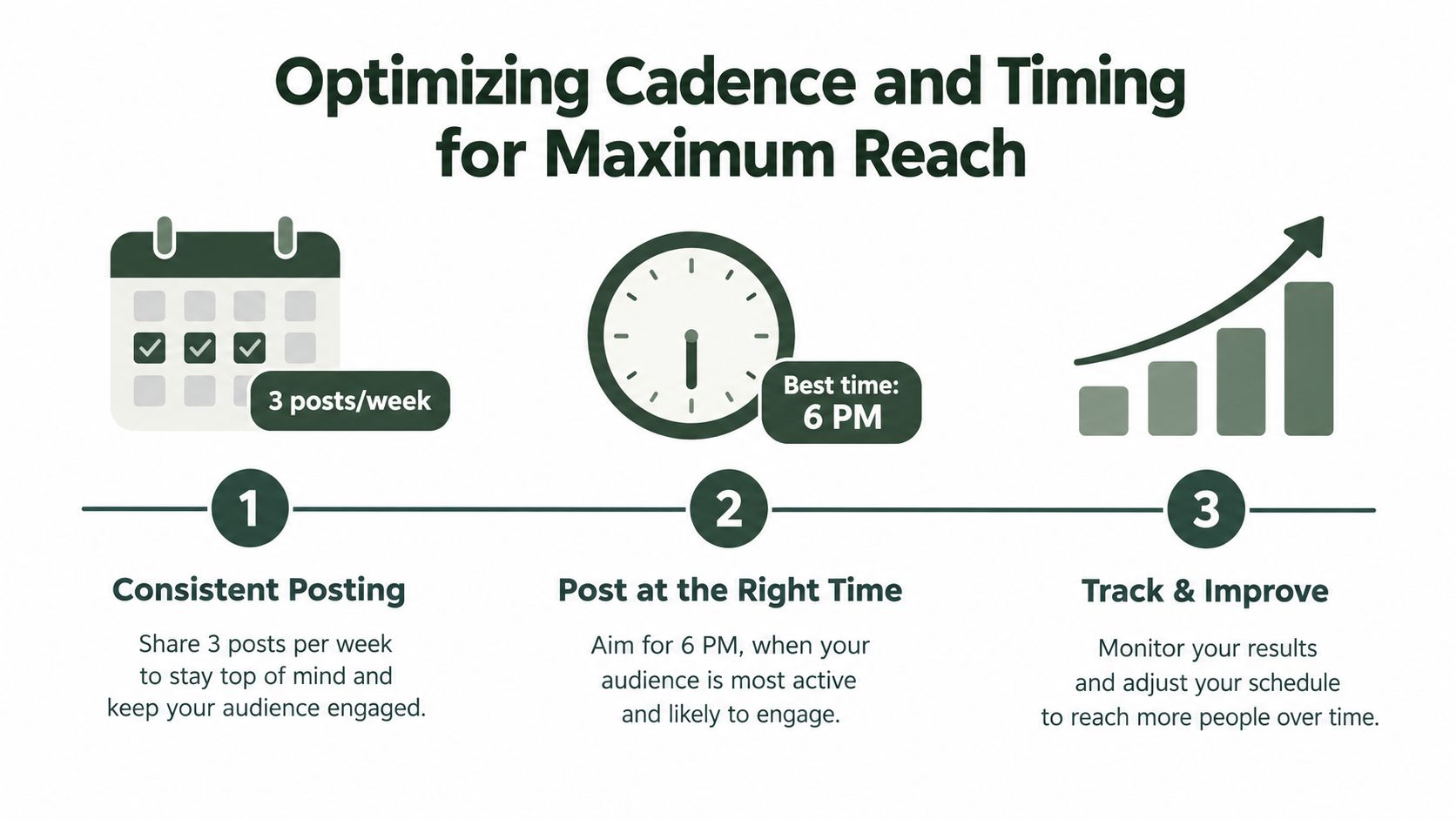
Consistency creates learning opportunities, but volume isn't a substitute for relevance. A reliable publishing schedule gives your team enough performance data to identify patterns, while excessive output can make each post compete with the next one for attention.
Buffer's 2026 benchmark analysis found median monthly publishing volumes of 35 posts on Facebook, 17 on Instagram, 8–9 on TikTok, 9 on X, and roughly 6.5 on LinkedIn. The figures are useful as operating context, not as mandatory quotas.
Set a cadence your team can sustain
Use a simple sequence:
- Choose a baseline: Start with a schedule your team can maintain without lowering quality or abandoning replies.
- Keep the pattern stable: Publish consistently long enough to compare similar formats and topics.
- Review engagement per post: Total output may rise while the response to each post falls.
- Adjust one variable: Change cadence, timing, or format separately so you can identify the cause.
- Protect response capacity: Don't publish more than the team can support in comments and messages.
Buffer reported that regular posting produced 5x more engagement in an analysis of more than 100,000 users. The same source also described 6–7 posts per week as an optimal frequency in another study, with engagement and positive brand mentions declining when accounts posted more often. The trade-off is clear. Consistency helps, but overposting can dilute attention and sentiment.
Use timing as a test variable
A separate analysis of 52 million Facebook posts across 213,000 accounts reported the strongest posting time as 5 a.m. on Mondays for Facebook, 3 p.m. on Fridays for Instagram, and 8 p.m. on Sundays for TikTok. These are starting points, not replacements for your own audience data.
Use the platform-specific data to create initial publishing windows, then compare results by reach, engagement rate, and action type. A post published at a benchmark time can still fail if the opening is weak or the format doesn't fit the audience.
For TikTok-specific scheduling decisions, consult this practical guide on when to post on TikTok. Keep the test disciplined. If you change the hook, length, posting time, and target audience at once, the resulting data won't tell you what worked.
The following video provides a visual explanation of how cadence and timing can be organized in a repeatable workflow.
Designing Captions and Calls to Action That Drive Interaction
A caption shouldn't repeat the graphic or narrate the video. It should reduce the effort required to understand the idea and make the next action obvious. Strong captions give the audience a reason to pause, a useful detail to retain, and a response that feels relevant rather than manufactured.
Write for the channel
The same subject needs different copy on different networks. A LinkedIn post may lead with the business consequence, then unpack the reasoning in short paragraphs. An Instagram caption can use a sharper opening and point readers toward a saveable checklist. A TikTok caption should support the video instead of competing with it. On X, a focused claim or question may be more effective than a long explanation.
Use line breaks deliberately. Keep one idea per paragraph, place the most important context early, and remove setup that doesn't help the reader decide whether to continue. Teams publishing professional posts can use the LinkedIn text formatter to improve scanability before approval.
A practical caption structure looks like this:
- Opening tension: Name the problem or surprising observation.
- Useful middle: Give a method, example, or distinction the audience can apply.
- Specific action: Ask for one response that matches the content.
- Conversation bridge: Add a question only when the answer will inform future content.
Ask for meaningful behavior
A weak CTA asks for approval. A stronger CTA asks for an action connected to utility or identity:
- “Save this checklist for your next content review.”
- “Share this with the person who owns your publishing calendar.”
- “Which part of the workflow creates the most delay for your team?”
- “Reply with the format that earns your highest-quality conversations.”
Avoid engagement bait that asks people to comment without giving them anything to discuss. “Comment yes if you agree” may create activity, but it produces little insight and can make the brand sound mechanical. A focused question works better when the post has already supplied enough context to answer it.
Use one CTA at a time
Multiple calls to action divide attention. If your goal is saves, don't finish with a request for comments, shares, DMs, and clicks. Choose the action that best matches the post's purpose and make the wording concrete.
Review captions against the signal you're measuring. If the post is meant to drive redistribution, assess shares and sends. If it teaches a process, assess saves and return interactions. If it introduces a point of view, assess the quality of replies rather than counting every reaction equally.
Building Community Through Active Engagement Management
Publishing opens the engagement loop. Community management determines whether it continues. Brands strengthen repeat participation by answering relevant comments, acknowledging useful criticism, and following up when people ask for more information.
Treat every interaction as operational insight. Repeated questions expose gaps in the explanation. Objections show where an offer needs clearer support. Detailed replies reveal which examples resonate with the intended audience. The inbox is an editorial research queue, not just a list of tasks.

Create a response protocol
Small teams need consistent routing, not identical replies for every message.
- Answer directly: Respond to product questions, clarification requests, and positive comments with useful information.
- Continue the thread: Ask a follow-up when the topic merits further discussion.
- Escalate carefully: Send complaints, legal concerns, safety issues, and sensitive customer details to the appropriate owner.
- Record patterns: Convert recurring questions into briefs for future posts, FAQs, or product education.
- Close the loop: Return to the conversation when the promised answer or update is available.
Response speed matters, but judgment matters more. A quick generic reply can feel inattentive, while a slower response that addresses the actual question can build trust. Use saved replies for predictable requests, then customize the detail that relates to the person's situation.
Use a clear community engagement framework to assign ownership, define escalation rules, and connect daily conversations with broader marketing goals. Pair that process with channel-specific how to write captions guidance so responses match the context, tone, and interaction patterns of each platform.
Engage beyond your own posts
Active engagement extends beyond notifications on the brand account. Join relevant conversations when your expertise adds value. Keep product mentions out of unrelated discussions, and avoid chasing every viral topic. External participation works best when it connects to the audience, subject area, or customer problem.
Measure community work through substantive replies, repeat participants, direct messages that begin in conversations, and recurring questions. These signals distinguish a durable audience relationship from a short-lived reaction spike and show which discussions deserve follow-up.
Platform distribution also responds to meaningful activity around content, but the goal is not to manufacture comments. A thoughtful response can bring someone back, extend a discussion, and establish the account as an active participant rather than a broadcast channel. Review those interactions by platform, then adjust routing, response depth, and escalation rules according to the conversations each channel produces.
Scaling Execution With an Autonomous AI Agent
Cross-channel execution usually breaks at the handoffs. One person drafts the copy, another adapts the visual, someone else schedules it, and a fourth person assembles a report after the campaign has already moved on. Each handoff introduces delay and increases the chance that a platform-specific detail gets lost.
An autonomous AI agent changes the operating model by coordinating the work from brief to approval. It doesn't remove human judgment. It handles repeatable production and routing while people retain control over what gets published.
A practical campaign workflow
Consider a growing brand preparing a product education campaign across LinkedIn, Instagram, TikTok, and X.
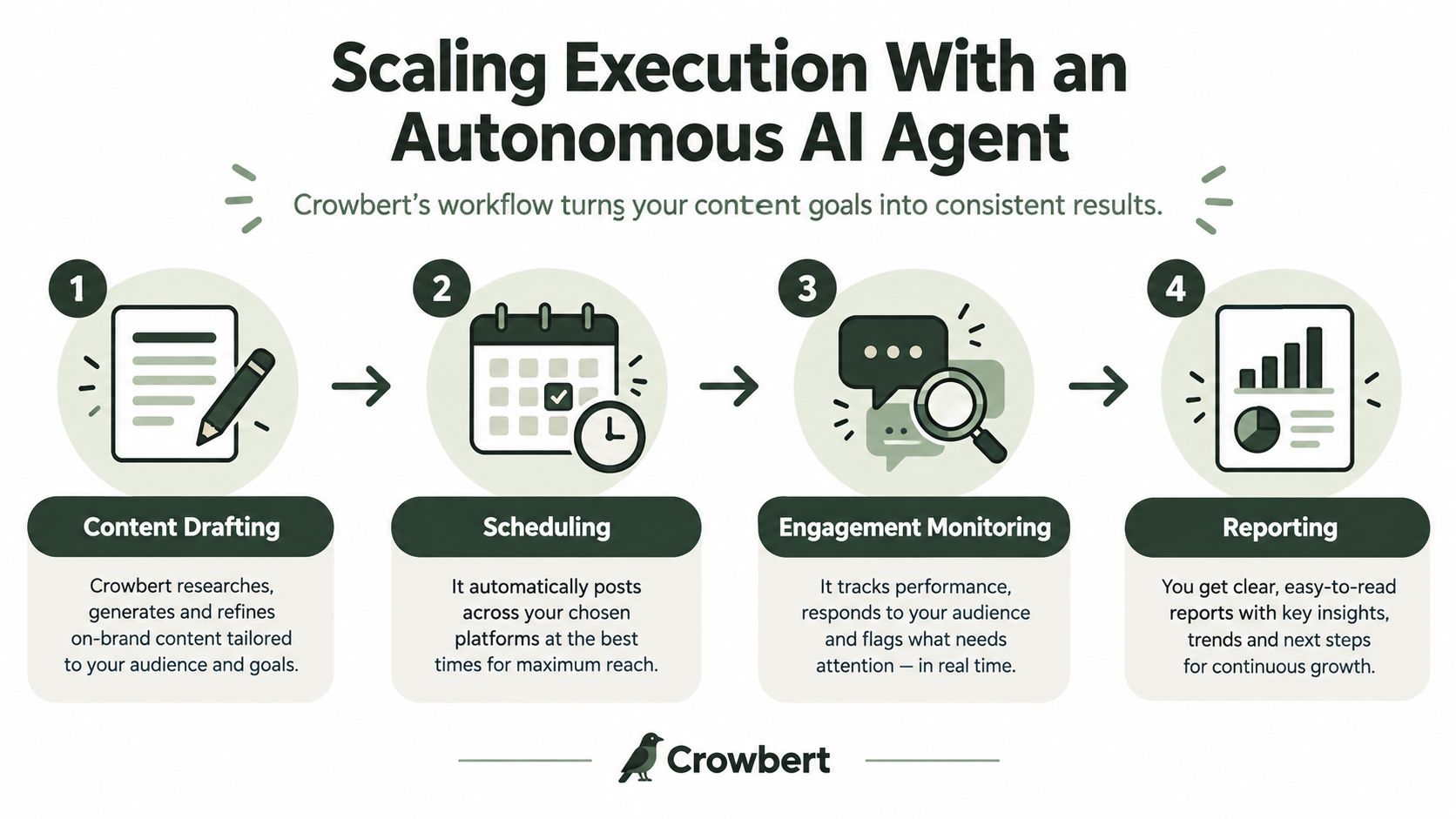
The strategist begins with one brief: audience, proposition, proof points, prohibited claims, preferred tone, and the engagement action that matters. Crowbert's dedicated autonomous AI agent can coordinate specialized work for drafting, creative production, planning, publishing, engagement management, and analysis. The system adapts the central idea for each channel rather than treating one exported asset as a complete campaign.
The workflow then moves through four controlled stages:
- Draft: Generate platform-specific captions, visual concepts, short-form video directions, and alternative hooks.
- Review: Present the proposed content for human approval, with brand rules and campaign context visible before publishing.
- Execute: Schedule and publish approved content across the selected channels, using the appropriate format and timing.
- Learn: Consolidate performance data, identify strong signals, and recommend changes to the next batch.
Teams researching how to schedule AI agent content will find that execution quality depends on more than automation. The agent needs durable brand context, clear approval boundaries, channel-aware formatting, and a way to turn performance feedback into the next production decision.
Keep autonomy inside guardrails
The useful distinction is between autonomous execution and unsupervised publishing. A system can draft, adapt, schedule, triage, and report while still requiring explicit human approval before anything goes live. That structure is particularly important when multiple stakeholders need visibility or when posts may involve regulated, sensitive, or reputationally important subjects.
The agent should also preserve the measurement logic established earlier. It needs to report the denominator used, separate platform results, distinguish shares from likes, and connect community responses to content decisions. Otherwise, automation just produces more activity without improving the system.
For a solo founder, that may mean turning a rough voice brief into an approved weekly batch. For an agency, it may mean managing multiple client workspaces without repeating the same production handoffs. For an in-house team, it can provide a shared workflow for creative, scheduling, replies, and reporting while keeping final judgment with the people responsible for the brand.
Frequently Asked Questions
What is a good social media engagement rate?
There is no universal benchmark. Each platform uses different distribution signals and reporting formulas, so compare performance within the same network, against earlier posts, and across similar formats. Treat any published benchmark as directional context rather than a target.
A post can perform well with a lower visible rate if it reaches the right audience or generates qualified conversations. Distribution and business value matter alongside the percentage.
How is engagement rate calculated?
The formula is total engagements divided by a chosen denominator, multiplied by 100. That denominator may be followers, reach, impressions, or views, so label the method in every report. Depending on the platform and objective, engagements can include likes, comments, shares, saves, clicks, or messages.
Follower-based measurement helps assess account performance over time. Reach-based measurement is often better for evaluating an individual organic post, while impressions or views can suit campaigns where repeated exposure affects results.
Why has social media engagement dropped?
Check distribution mechanics before replacing the entire strategy. Possible causes include a format mismatch, weaker openings, repetitive topics, timing that conflicts with audience behavior, inconsistent publishing, or slow responses to active conversations.
Review results by platform and signal. Stable likes with falling shares or saves can indicate reduced usefulness. Falling reach with steady engagement by reach points more toward distribution than audience relevance.
Should a business optimize for likes or comments?
Choose the signal that matches the business objective. Saves can indicate reference value, shares show redistribution, comments support discussion, DMs may signal intent or support needs, and watch time helps evaluate video retention.
Likes still show lightweight resonance, but they should not decide whether a post worked. A smaller post that creates qualified conversations can matter more than a larger post built on passive approval.
How can a small team improve engagement without adding more manual work?
Standardize the workflow before increasing output. Create channel-specific templates, define response categories, document escalation rules, batch production, and review results in a consistent dashboard. An autonomous AI workflow can draft, adapt, schedule, triage, and report while human approval remains in control.
The practical goal is a measurable system: platform-specific inputs, clear engagement definitions, and feedback that changes the next content decision. A collection of proven social media engagement strategies can provide ideas, but test each tactic against your own baseline and measurement formula.
Crowbert provides an autonomous AI agent for end-to-end social media work, including content creation, channel-aware scheduling, engagement management, and performance reporting with human approval before publishing. Visit Crowbert to see how your team can turn engagement strategy into a repeatable execution workflow.
About the Author
The team behind Crowbert building AI-powered marketing tools that help businesses of all sizes create professional campaigns, manage social presence, and drive real results.