Community Engagement Framework That Actually Works
Build a community engagement framework that turns scattered replies into a measurable system. Includes KPIs, SLAs, and AI agent workflows.
You start the morning with 200 unread notifications, three platforms telling different stories, and a VP asking for engagement numbers by Friday. People are commenting, asking for help, flagging problems, and praising the brand, but nothing underneath the activity tells the team who should respond, how quickly, or what happens next.
A community engagement framework turns that noise into an operating system. It connects community goals to ownership rules, response standards, moderation tiers, escalation paths, advocacy mechanics, and measurable review cycles. The framework below is designed for small teams that need enterprise-level discipline, including teams using an autonomous AI agent while keeping human approval over publishing.
Table of Contents
What a Community Engagement Framework Actually Is
A content calendar tells you what the brand plans to publish. A brand voice document describes how the brand should sound. Neither answers the operational question that matters after publication: what happens when a comment arrives?
A community engagement framework is the missing layer between strategy and daily behavior. It defines:
- Objectives: The outcomes the community should influence, such as retention, support efficiency, trust, or product feedback.
- Ownership: The person responsible for triage, drafting, approval, escalation, and follow-up.
- Response standards: The expected time and quality of the first meaningful reply.
- Moderation tiers: The rules for routine questions, sensitive issues, abuse, legal concerns, and potential crises.
- Advocacy mechanics: The signals that identify helpful members and the approved ways to deepen those relationships.
- Measurement: The indicators a manager can audit and use to change staffing, cadence, or routing.
That distinction matters because activity isn't the same as engagement. A team can publish consistently and still leave customer questions unanswered. It can track comment volume while missing a high-risk complaint. It can celebrate positive sentiment without knowing whether the conversation led to resolution, repeat participation, or useful product insight.
Start by documenting the daily response loop in a simple community management workflow. List every inbound source, assign a queue owner, define the required response, and record what closes the interaction. The system should be repeatable enough for a new moderator to follow and structured enough for an AI agent to execute without inventing its own policies.
The World Health Organization's community engagement framework, published in 2017, treated engagement as something to embed across health-system design and delivery rather than bolt on as outreach. WHO's community engagement framework connects participation with trust, accountability, and service responsiveness. The same operating logic applies to social programs: community input must influence decisions, and the organization must show how it responded.
The Four Layers of a Working Framework
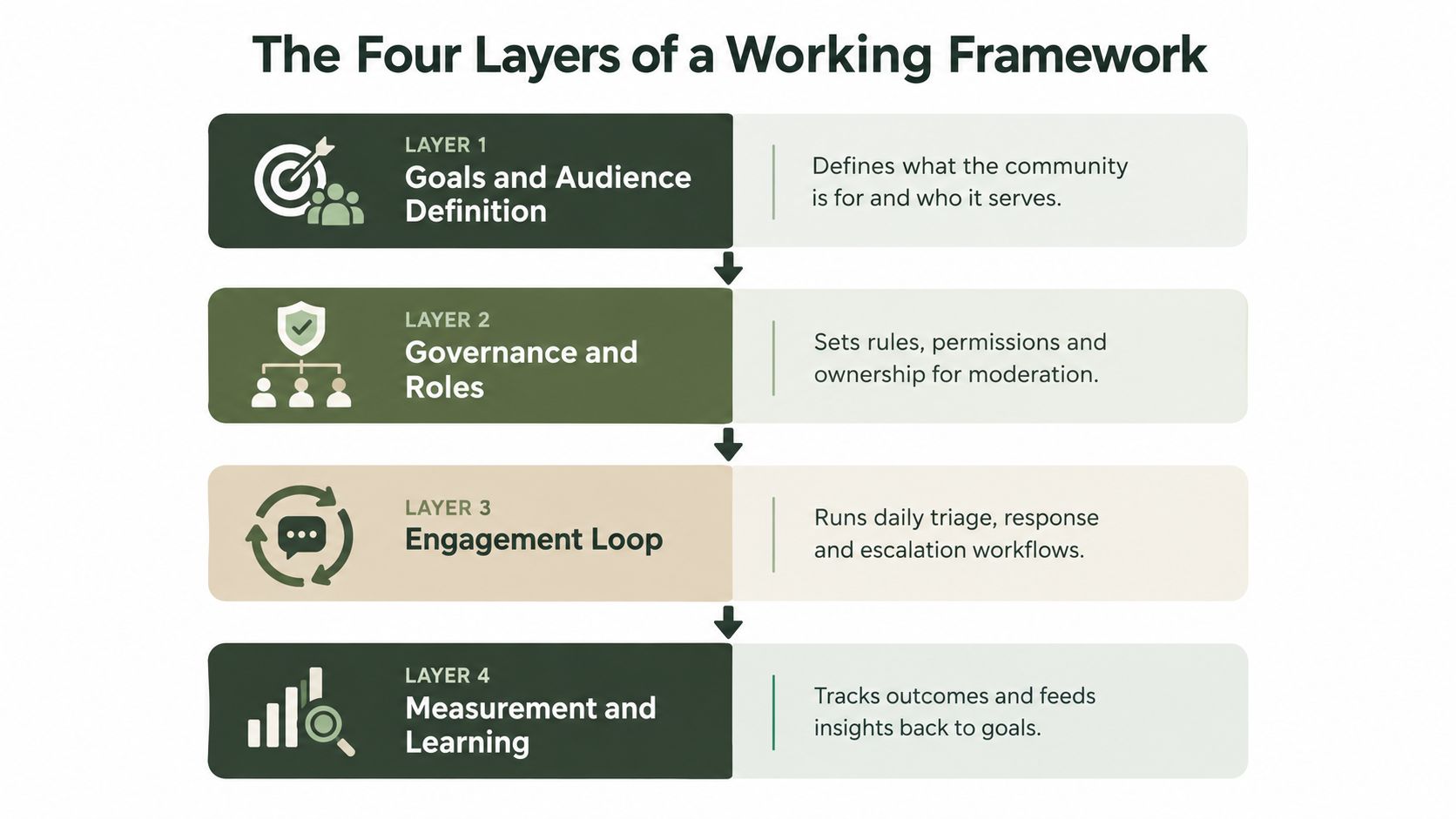
A durable system has four dependent layers. Each one answers a different management question, and skipping one creates failure above it.
Layer one defines purpose and audience
First decide what the community is for and who it serves. Choose three to five meaningful outcomes, such as reducing repetitive support work, improving retention, gathering product feedback, strengthening trust, or developing customer advocates.
Audience definition needs more detail than a demographic label. Document member intent, account importance, geographic or language needs, likely risks, and the channels where each group participates. A founder community may need peer learning and recognition. A product support community may need accurate troubleshooting and fast escalation. The same publishing cadence won't serve both.
Layer two assigns governance and ownership
Write down who answers, who approves, and who escalates. Typical participants include a community manager, support specialist, subject matter expert, legal reviewer, communications lead, and an AI agent handling first-pass triage.
The AI agent shouldn't become an owner by default. It can classify, route, and draft, while a named human remains accountable for sensitive replies and final approval. Governance also includes permissions, banned language, privacy rules, response templates, and the conditions that move an interaction to a senior queue.
For a broader view of how purpose, internal organization, inclusion, communication, measurement, and continuity fit together, Bazzly's guide to founder community growth is a useful complementary resource.
Layer three turns expectations into KPIs and SLAs
The team needs measurable standards. Possible operating targets include first response under 60 minutes during business hours, resolution under 24 hours, sentiment movement, advocacy rate, and moderator accuracy. These are internal service commitments, not universal benchmarks, so set them according to risk, staffing, and audience expectations.
A useful KPI must trigger a decision. If response time slips, change routing or coverage. If moderator accuracy falls, improve the policy library or send more cases to human review. If advocacy activity stays low, examine whether the team is recognizing helpful members or merely collecting reactions.
Layer four connects process to tooling
The final layer contains moderation tiers, playbooks, automation rules, escalation paths, approval workflows, and analytics. It should show where a comment enters, where its status changes, and where the final outcome is recorded.
Content pillars can help organize the outbound side of this system, but they don't replace response governance. The distinction is covered in this guide to content pillars. A working framework connects those pillars to the inbound queue, so the team can support the conversations its publishing creates.
Platform Cadence and Posting Windows Inside the Framework
Platform cadence belongs inside the framework because every post creates response work. The following reference uses the supplied independent scheduling guidance for Facebook, Instagram, X, and LinkedIn. No verified figures were provided for Reddit, TikTok, or YouTube, so those entries should be validated against the audience's own analytics rather than filled with invented benchmarks.
Platform Cadence and Posting Windows Reference
| Platform | Posts per Week | Peak Window, Local | Post Half-Life |
|---|---|---|---|
| 2 to 5 | Tuesday through Thursday, 9 am to 12 pm | Validate with account data | |
| 4 to 7 feed posts, plus daily Stories | 12 pm to 1 pm or 5 pm to 6 pm | Validate with account data | |
| TikTok | Set from account data | Set from account data | Validate with account data |
| X | 3 to 5 tweets daily | 12 pm to 1 pm or 4 pm to 5 pm | Validate with account data |
| 3 to 5 | Weekdays, 12 pm to 3 pm, especially Wednesday and Thursday | Validate with account data | |
| Set from account data | Set from account data | Validate with account data | |
| YouTube | Set from account data | Set from account data | Validate with account data |
The supplied scheduling guide recommends Facebook 3 to 5 times per week, Instagram 4 to 7 feed posts per week plus daily Stories, X 3 to 5 posts daily, and LinkedIn 2 to 5 times per week, with the windows shown above. The platform timing guidance should be treated as a starting reference, not a replacement for account-level evidence.
The framework rule is simple: publish only what the response queue can absorb. A high-volume channel with unanswered questions creates a visible service failure. A smaller cadence with reliable replies can produce a healthier community experience.
Use scheduling to protect consistency, then reserve time for live interaction. One scheduling guide recommends scheduling 80% of content in advance and leaving 20% open for real-time engagement, with 15 to 30 minutes per day blocked for community interaction. The scheduling discipline guidance supports a useful operating split: automation handles predictable output, while people and agents stay available for context.
For execution details, use a social media scheduling workflow that connects publishing to approval and response capacity instead of treating the calendar as a separate department.
The Engagement Loop from Triage to Advocacy
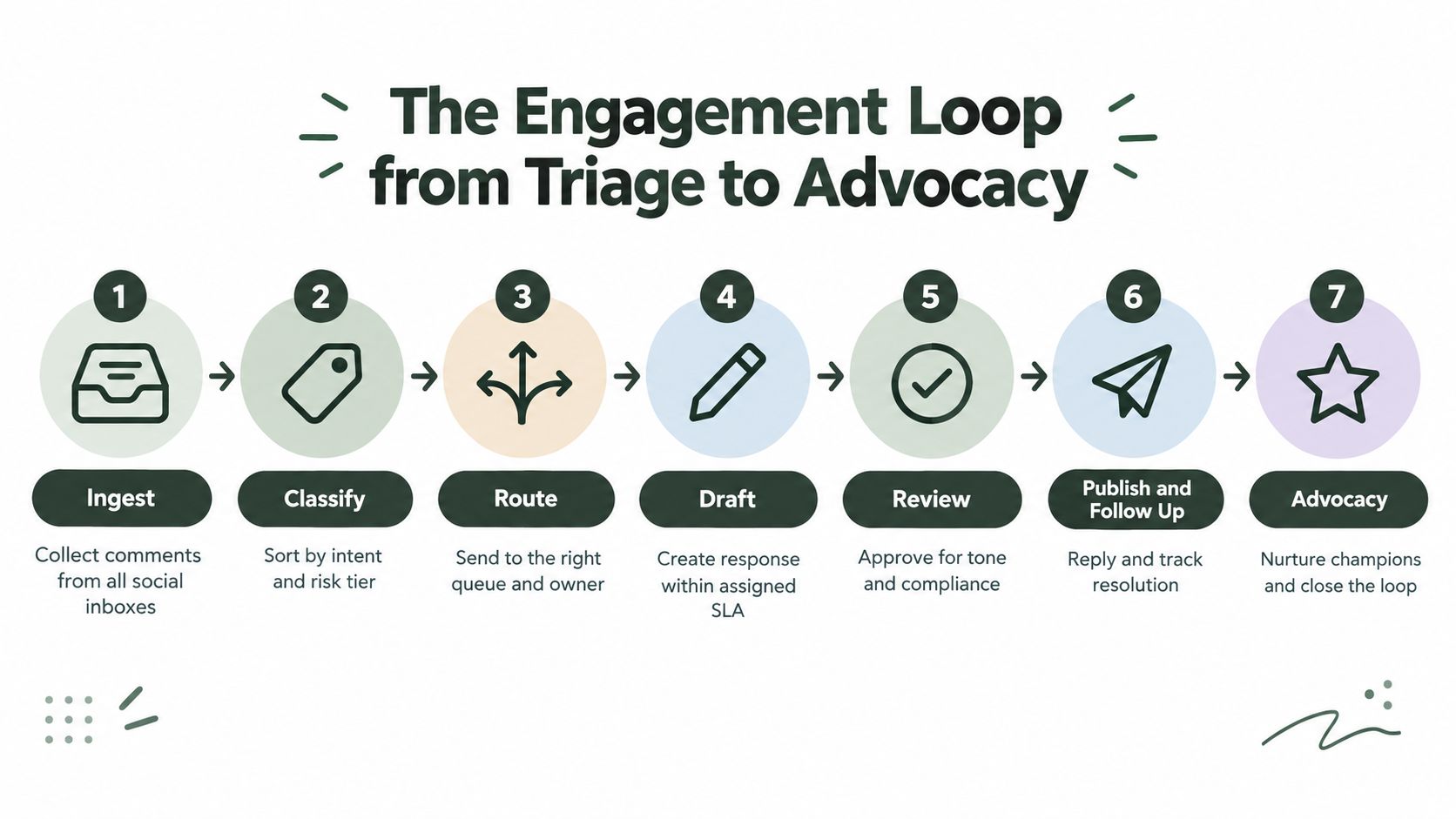
A comment should travel through a defined path, not sit in a shared inbox until somebody notices it. The seven-stage loop below gives every interaction a status, an owner, and a next action.
- Ingest: Collect comments, mentions, replies, and direct messages from every connected channel.
- Classify: Identify intent, sentiment, product or service reference, account importance, and risk tier.
- Route: Send the interaction to the routine, support, senior, legal, or communications queue.
- Draft: Prepare a response that follows the approved voice and policy library.
- Review: Check tone, accuracy, privacy, compliance, and escalation requirements.
- Publish and follow up: Send the approved reply, track resolution, and request internal action when needed.
- Advocacy: Identify helpful members, recognize their contribution, and invite appropriate next steps.
Build a triage matrix before writing response templates. At minimum, map sentiment, intent, product mention, account tier, and risk to a priority and owner. A routine product question may go to a support queue. A legal allegation, threat, executive mention, or press inquiry should bypass junior moderation.
Set default service levels, then adjust them to your actual coverage:
- Crisis and executive mentions: 15 minutes.
- Support questions: 1 hour.
- General conversation: 4 hours.
- Low-value mentions: 24 hours.
These are operating defaults for the framework, not claims about universal service expectations. The important point is that each tier has a clock, and the clock has an owner.
Escalation should be explicit. A junior moderator can handle routine questions, a senior community manager can take sensitive dissatisfaction or repeated failure, and legal or communications specialists can handle toxicity, legal exposure, or press interest. The stack can be a unified social inbox, a customer service workspace, or a channel-based internal workflow. The tool matters less than whether every stage leaves a record.
Use a comment response process that separates acknowledgement, resolution, escalation, and follow-up. A reply isn't complete merely because it was published. The loop closes when the issue is resolved, the member confirms the outcome, or the case is transferred with a documented reason.
Where an AI Agent Fits Without Losing Human Control
An AI agent belongs in the framework as an execution layer with strict boundaries. It can perform first-pass triage and routing, generate drafts from approved policies, and tag post-publish interactions for advocacy review. It shouldn't decide on its own what the brand is allowed to promise.
The handoff contract should be machine-readable and easy for a moderator to inspect. For each interaction, the agent returns:
- Intent and sentiment
- Risk tier and routing destination
- Draft response
- Policy citations
- Confidence score
- Recommended next action
The agent waits for human approval before publishing anything above Tier 2. The organization can also require approval for every message during the initial rollout, then expand automation only where the audit record shows reliable performance.
Crowbert's model illustrates this structure as an autonomous AI agent that executes social media work end to end while keeping human approval in control. A configured agent can inherit tone rules, escalation thresholds, and a banned-phrase list, then use those controls while drafting and routing inside the AI agent for social media workflow.
The safeguards matter more than the novelty. Add a kill switch that disables publishing without deleting the queue. Route low-confidence drafts to a human-only review queue. Keep an audit log of the prompt, returned classification, draft, policy citation, approval decision, and final published text.
Teams assessing implementation patterns can also review this guide to integrating AI agents, especially when the agent needs to connect with existing approval and service workflows.
Don't give the agent an undefined mandate such as “manage the community.” Give it bounded actions, clear rejection conditions, and a visible handoff path. That design preserves judgment where context matters while removing repetitive sorting and drafting work from the human queue.
A Worked Week Inside the Framework
A customer comments publicly about a billing error on Monday at 9:14 am. The agent classifies the interaction as billing support with medium sentiment, drafts a response from the approved policy library, and routes it to a human moderator.
The moderator approves and replies in 38 minutes, within the framework's 1-hour support SLA. The customer responds the next day with thanks. Advocacy rules flag the interaction because the customer used the brand name without prompting and has more than 500 followers.
The loop creates a second outcome
On Wednesday, the advocate tag triggers an opt-in direct message. It offers a referral code and an opportunity to join the community advisory board. The message doesn't assume consent, and it doesn't treat a public thank-you as permission for unrelated marketing.
From Thursday through Friday, the continued conversation feeds the weekly KPI report. The report records response time, sentiment shift, and advocacy conversion, while preserving the original thread for review.
The Friday retrospective references the interaction because the team converted a support case into an advocate. The useful lesson isn't that every billing complaint will produce the same result. It's that a defined system can recognize a resolved issue, identify an appropriate next action, and measure whether that action created value.
What the Framework Measures and What It Refuses To
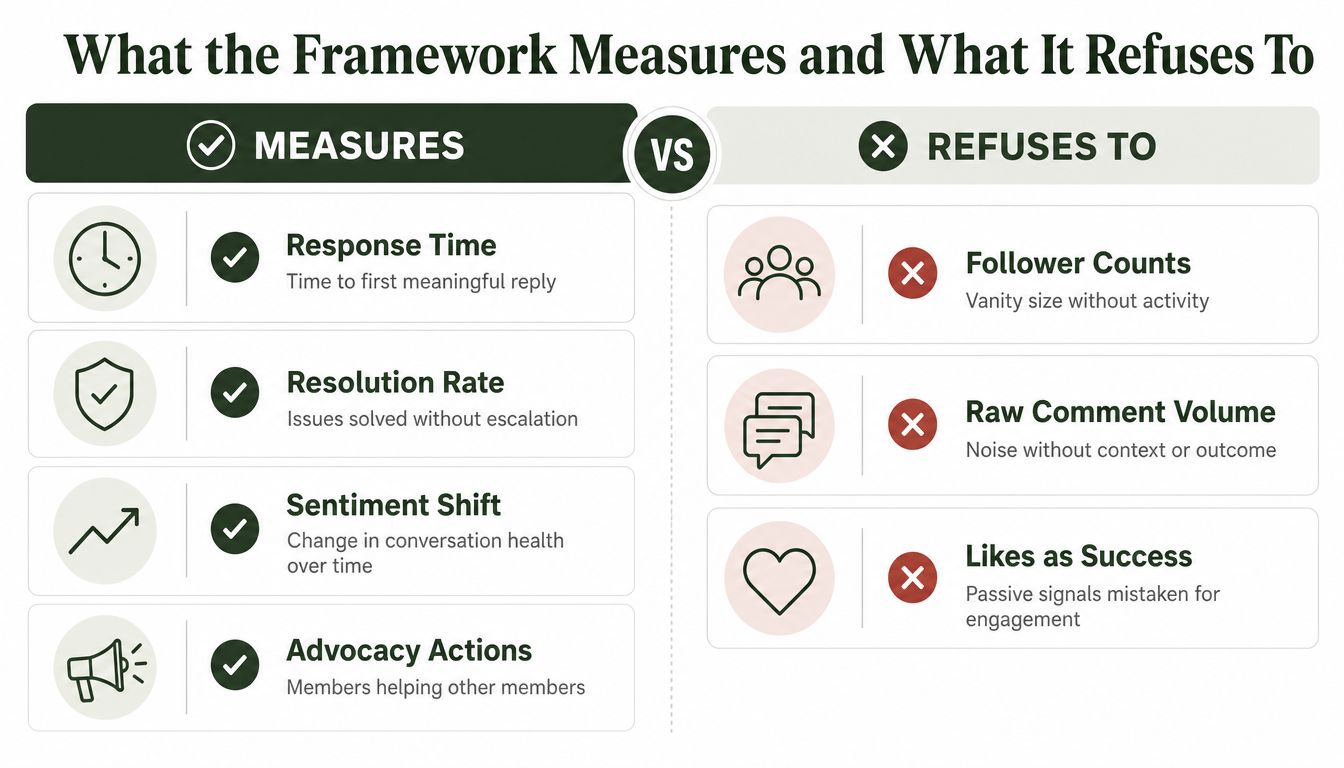
Follower count is not community health. Raw comment volume is not proof of participation, and a generic sentiment score can't explain whether the team solved a problem. Those signals can provide context, but they shouldn't sit at the center of the operating dashboard.
A defensible framework measures behavior and outcomes that managers can change:
| Measures | What it tells the team |
|---|---|
| Response SLA attainment | Whether the assigned queue meets its service commitment |
| Moderation actions by tier | Where risk and workload are concentrated |
| Escalated issue resolution time | Whether handoffs are moving cases toward closure |
| Repeat engagement rate | Whether members return for meaningful interaction |
| Advocacy conversions | Whether helpful participation leads to an approved next step |
| Inbound to outbound ratio | Whether the team is responding to demand or creating more demand than it can handle |
The framework intentionally excludes follower counts as a primary success signal, raw comment volume without context, and likes treated as equivalent to active participation. It also avoids an oversized dashboard that produces reports but no decisions.
UNICEF's guidance provides a useful measurement discipline, defining 16 minimum quality standards across Core Standards, Implementation, Coordination and Integration, and Resource Mobilization, with at least one indicator recommended for each standard. UNICEF's minimum quality standards and indicators show how inclusion, planning, and management can be evaluated separately rather than collapsed into one score.
NICE has noted that existing evaluation approaches often lack detail and that their usefulness remains unclear, while calling for shared methods that allow comparison. The NICE guidance on evaluating community engagement reinforces the need to measure more than attendance or activity counts.
Review the metrics monthly. Change cadence when response load rises, add staffing when a queue repeatedly misses its SLA, and tighten AI routing when low-confidence cases reach the wrong owner. The report should tell leadership what changed and what the team will do next.
Frequently Asked Questions
What team size do we need to start?
A small team can begin with one accountable owner, a documented escalation partner, and a defined approval path. Start with the channels and interaction types you can cover consistently, then expand when the response queue and SLA data support it.
How much time does implementation take?
The work is less about building a large strategy deck and more about documenting decisions. Define objectives, queues, response tiers, policies, SLAs, and reporting first, then test the loop on routine interactions before adding complex automation.
Can the framework connect with our existing help desk or CRM?
Yes, if the workflow preserves a shared identifier, owner, status, escalation reason, and resolution outcome. The social layer should route support cases into the existing service process rather than create a disconnected second record.
What changes when an AI agent enters the loop?
The agent can classify conversations, route work, draft replies, and apply advocacy tags, but human approval should remain mandatory for sensitive or higher-risk publishing. Use confidence thresholds, a kill switch, policy citations, and an audit log so the team can inspect every decision.
How should leadership see progress in the first 90 days?
Report SLA attainment, moderation volume by tier, escalated resolution time, repeat engagement, advocacy conversions, and inbound-to-outbound ratio. Pair each metric with an operational decision, such as changing coverage, revising a playbook, adjusting cadence, or rerouting low-confidence work.
The practical next step is to audit one week of inbound interactions and label the intent, risk, owner, response time, and outcome for each thread. That sample will show where the framework needs a new rule before you automate anything.
Crowbert provides an autonomous AI agent that can coordinate social media work from drafting and scheduling through engagement and reporting, with human approval controlling publication. Visit Crowbert to see how its agent-centered workspace can support a repeatable community engagement loop.
About the Author
The team behind Crowbert building AI-powered marketing tools that help businesses of all sizes create professional campaigns, manage social presence, and drive real results.


