Social Media Reputation Monitoring That Actually Works
Learn social media reputation monitoring that works: the metrics to track, the response workflow to run, and how an AI agent turns noise into ranked action.
53% of customers expect a company to answer a negative review within one week, yet 87% of businesses fail to meet that expectation. That response-time gap is the operational problem behind social media reputation monitoring. A dashboard full of mentions won't protect a brand if nobody knows which alert matters, who owns it, or whether a response can be approved before the conversation moves elsewhere.
Effective monitoring isn't about reacting to every criticism. It's about identifying the public conversations that can change trust, ranking them by risk and reach, and moving the right response through a controlled workflow. The best system combines continuous collection, practical thresholds, fast drafting, and human approval.
Table of Contents
What Social Media Reputation Monitoring Really Means
Social media reputation monitoring is the continuous practice of collecting, classifying, and acting on public conversation that can shape how people perceive a brand. That conversation can appear on social networks, forums, review sites, and comment sections beneath owned content, earned media, or creator coverage.
The distinction matters. Broad social listening supports research into audiences, trends, and market language. Reputation monitoring has a narrower operational purpose: find conversations that could affect trust, demand, customer relationships, regulatory exposure, hiring, or public credibility, then route them to someone who can act.
It also isn't the same as customer support ticket triage. A support queue is usually private and account-specific. Reputation monitoring includes public complaints, recurring themes, influential criticism, misinformation, and praise that can shape what other people believe.
Define the scope before setting alerts
A useful monitoring program deliberately excludes several categories:
- Paid ad performance: Campaign metrics belong to media optimization, not reputation triage.
- Internal team chatter: Private workplace discussion requires separate governance and tools.
- Vanity follower counts: Follower growth rarely determines whether a public issue needs intervention.
- Low-consequence mentions: Not every reference can realistically reach a buyer, journalist, regulator, employee, or decision-maker.
Four inputs bound the discipline:
- Author reach: A post from a high-reach account deserves more attention than an isolated low-distribution comment.
- Sentiment: Anger, fear, disappointment, praise, and neutral inquiry require different handling.
- Topic relevance: A product safety concern has a different risk profile from an off-topic joke.
- Spread velocity: A conversation accelerating across accounts or channels demands earlier review.
Review expectations reinforce the need for a policy. 81% of consumers trust a business more when it responds to negative reviews, and 40% expect a reply within 24 hours. Those expectations make response speed part of credibility, not merely a customer-service preference.
Set a working target of first review within one hour for high-risk public mentions, with lower-risk items handled according to channel and staffing coverage. That doesn't mean publishing a rushed answer. It means the team has acknowledged, classified, and assigned the issue quickly. Teams that need to protect their ad spend on Meta should apply the same discipline to organic conversation, because paid visibility can amplify a public trust problem rather than hide it.
How Reputation Monitoring Became an Operational Discipline
Reputation work changed as public publishing became easier. Facebook rose in 2004, followed by Twitter in 2006, giving customers more ways to publish feedback and brands more opportunities to answer in near real time. By the 2010s, teams had shifted from reactive review handling toward proactive monitoring of social channels. In 2019, 72% of U.S. adults used social media, expanding the volume of brand-visible conversation that teams had to track. The evolution of reputation management explains that progression from review response to continuous channel oversight.
Early programs could treat reputation as a reporting function. A team might summarize sentiment periodically, identify recurring complaints, and bring the findings to a marketing or communications meeting. Distribution moved more slowly, and a delayed summary was still useful for planning.
That buffer has largely disappeared. Creator-led coverage, recommendation algorithms, screenshots, forums, and around-the-clock news cycles let a narrative move between audiences before a scheduled report reaches an executive. A post may begin as a customer complaint, become a screenshot on another network, and then reach journalists or industry communities through a different channel.
The operating inputs have changed
Modern monitoring teams need to measure more than raw mentions and average sentiment:
- Time to first review: How quickly did a person or agent assess the issue?
- Time to first approved response: How long did it take to move from detection to a publishable answer?
- Cross-channel duplication: Is the same narrative appearing in multiple places?
- Reach concentration: Is conversation being driven by a few high-reach accounts or many small ones?
- Resolution movement: Did the public issue enter support, product, legal, or communications workflows?
The broader monitoring market reflects this demand for reputation oversight. Independent market summaries place the global media monitoring market at 4.12 billion in 2022** and **4.25 billion in 2023, while social media monitoring alone reached 410 million in 2023**. Other projections place the broader market at **13.71 billion by 2030, with the social media monitoring segment projected to grow at a 13.5% CAGR from 2024 to 2032. These figures come from the market summary, and they describe market estimates and forecasts, not guaranteed outcomes for individual vendors.
The practical conclusion is simple: monitoring is now an on-call operating capability. The team must detect, rank, respond, escalate, and learn continuously.
The Metrics and Signals That Actually Matter
A reputation dashboard should help someone make a decision under pressure. If a metric doesn't change what the team does next, it belongs in a report, not in the on-call view.
Start with a historical baseline. Collect 30 to 90 days of historical data before setting alert thresholds, because that window captures ordinary business cycles and helps reduce false positives caused by launches or seasonal spikes. The technical monitoring baseline also identifies average daily mention volume, sentiment distribution, channel-level engagement rates, and competitor share of voice as useful measures, with continuous anomaly alerts for crisis indicators.
Rank signals by the decision they enable
| Metric | Decision It Drives | Act-On Threshold |
|---|---|---|
| Mention velocity | Whether a topic needs immediate review | Three times the trailing seven-day baseline inside one hour triggers investigation, not celebration |
| Sentiment share | Whether negative perception is becoming structural | Review a rolling 14-day ratio, not a single-day mood score |
| Share of voice | Whether the brand's narrative position is changing | Compare against a defined competitor set weekly |
| Reach-weighted mentions | Which authors deserve priority | Escalate high-reach accounts before aggregating low-reach volume |
| Topic-clustered negative sentiment | Whether a specific issue is emerging | Escalate when negative posts cluster around the same product, policy, or event |
| Response time | Whether service levels are realistic | Segment by channel and severity, then compare against staffing coverage |
| Resolution rate | Whether monitoring creates operational value | Track issues that moved from public conversation into support or another owner |
The velocity threshold above is a review trigger, not proof of a crisis. A product launch can produce a large, healthy conversation. A small number of highly connected accounts can create greater risk than a larger collection of unrelated complaints.
Reach weighting prevents a common mistake. Fifty low-reach mentions may signal dissatisfaction, but one account with a large relevant audience can change the urgency. Combine author reach with audience overlap, because a large account outside your buyer or stakeholder community may matter less than a smaller account whose followers include customers, employees, regulators, or journalists.
For teams refining their measurement model, RecensioAI reputation KPIs offers a useful reference point for separating activity measures from reputation outcomes. Crowbert's guide to measuring social media success is also useful when the team needs to connect engagement data with operational decisions.
Ignore the numbers that don't change triage
Don't let daily monitoring revolve around total follower growth, raw likes, or engagement rate on owned posts. Those measures can support content planning, but they rarely tell an on-call manager whether to escalate a complaint, pause a campaign, involve legal, or contact support.
If one composite signal deserves top placement, use velocity-adjusted negative reach from accounts above a defined follower floor. It combines how quickly the issue is moving, how negative the conversation is, and how much relevant distribution the authors can create. That signal won't replace judgment, but it gives a tired manager a better starting point than a generic sentiment score.
Turning Mention Noise Into a Ranked Response Workflow
A queue becomes useful only when it ranks mentions according to operational consequence. The ranking model should combine severity, channel reach, timezone coverage, and approval state.
Severity is the first filter. Classify mentions as complaint, question, crisis trigger, or neutral. A complaint may need a specific response and support handoff. A question may need a fast answer but no escalation. A crisis trigger can include allegations involving safety, discrimination, privacy, fraud, or regulatory exposure. Neutral mentions usually belong in observation unless reach or topic relevance changes their priority.
Channel reach and audience overlap come next. A criticism posted by a verified account with meaningful overlap with your buyer audience deserves attention even if total volume is modest. A sarcastic product post at two in the morning in the brand's local timezone may wait for review if it has no spread, low relevance, and no risk indicators.
Design the queue around real staffing
Timezone and shift coverage determine when a mention ages out. The queue should know whether someone is actively monitoring the channel, whether an escalation owner is available, and how long the response target remains realistic.
Approval state prevents the workflow from confusing drafting with publishing. A draft can move quickly while a sensitive response waits for legal, executive, or communications review. That distinction lets the team compress preparation without pretending that every message can go live immediately.
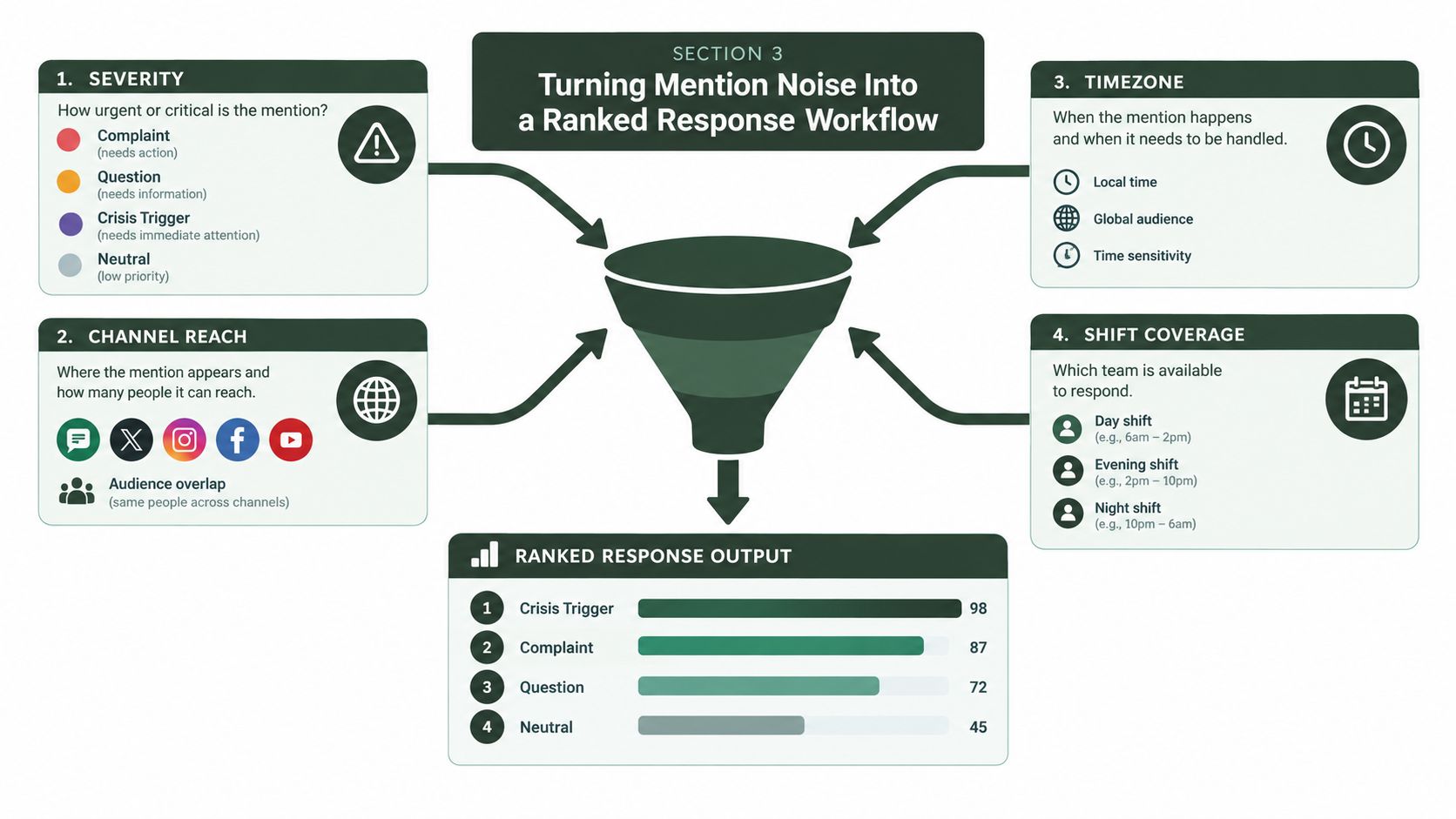
Consider two alerts arriving together. The sarcastic post at two in the morning has low velocity and no meaningful audience overlap. The verified-account complaint has clear relevance and follower overlap with prospective customers. The second alert should escalate within fifteen minutes, while the first can enter a monitored queue.
The common mistakes are predictable:
- Treating volume as urgency: A large harmless discussion can outrank a smaller high-risk allegation.
- Ignoring reach differentials: One influential author can matter more than many disconnected accounts.
- Using one triage path for every mention: Questions, complaints, and crisis triggers need different owners and approval rules.
A practical response workflow for comments should preserve that distinction. Response-time promises become credible only when the queue reflects who is available, what can be approved, and which conversations can still spread.
Comparing Tooling Approaches From Listening Suites to Agent Platforms
Teams usually choose among three operating models. Dedicated listening suites offer deep historical analytics, detailed taxonomies, and broad native channel coverage. Broader media intelligence platforms add earned news and broadcast monitoring, but social conversation is one input among several. Agent-driven platforms focus on closing the loop from detection to triage, drafting, approval, and reporting.
No category wins every requirement. The mistake is buying analytical depth while leaving response execution manual.
| Capability | Listening Suites | Media Intelligence | Agent-Driven Platforms |
|---|---|---|---|
| Historical analytics | Strong, with deep taxonomy and trend analysis | Strong across earned media and broader coverage | Practical operational analytics, usually with less taxonomy depth |
| Social channel coverage | Broad and specialized | Broad, but social is one part of the stack | Designed around connected social execution and engagement |
| Mention triage | Requires configured rules and human review | Often routes alerts for analyst handling | Automates classification and prioritization against brand criteria |
| Draft responses | Usually manual | Usually manual | Generates first drafts for human approval |
| Approval routing | Available through workflows, often configured by teams | Usually built around analyst and communications processes | Central to the response loop |
| Best fit | Teams with dedicated analysts and research needs | Organizations combining social, news, and broadcast intelligence | Teams that need continuous execution with human control |
Choose according to the bottleneck
A small team should generally lean toward an agent-driven model because its constraint is usually execution capacity. It needs monitoring, prioritization, drafting, and follow-up without adding multiple manual handoffs.
A mid-market team may pair a listening suite with an agent. The suite can preserve historical research and taxonomy depth, while the agent handles response preparation, routing, and approval. That combination adds integration work, but it addresses the central trade-off directly.
An enterprise team with dedicated analysts can place an agent over an existing stack as the action layer. Analysts retain ownership of taxonomy, risk definitions, and strategic interpretation. The agent handles repetitive ingestion, queue management, draft creation, and status tracking.
Human review remains necessary for legal risk, executive statements, safety claims, and crisis leadership. Automated systems can also help teams combat deepfakes with moderation, but content authenticity issues still require a clear escalation owner and evidence review.
Detecting Cross Platform Crises Before They Spread
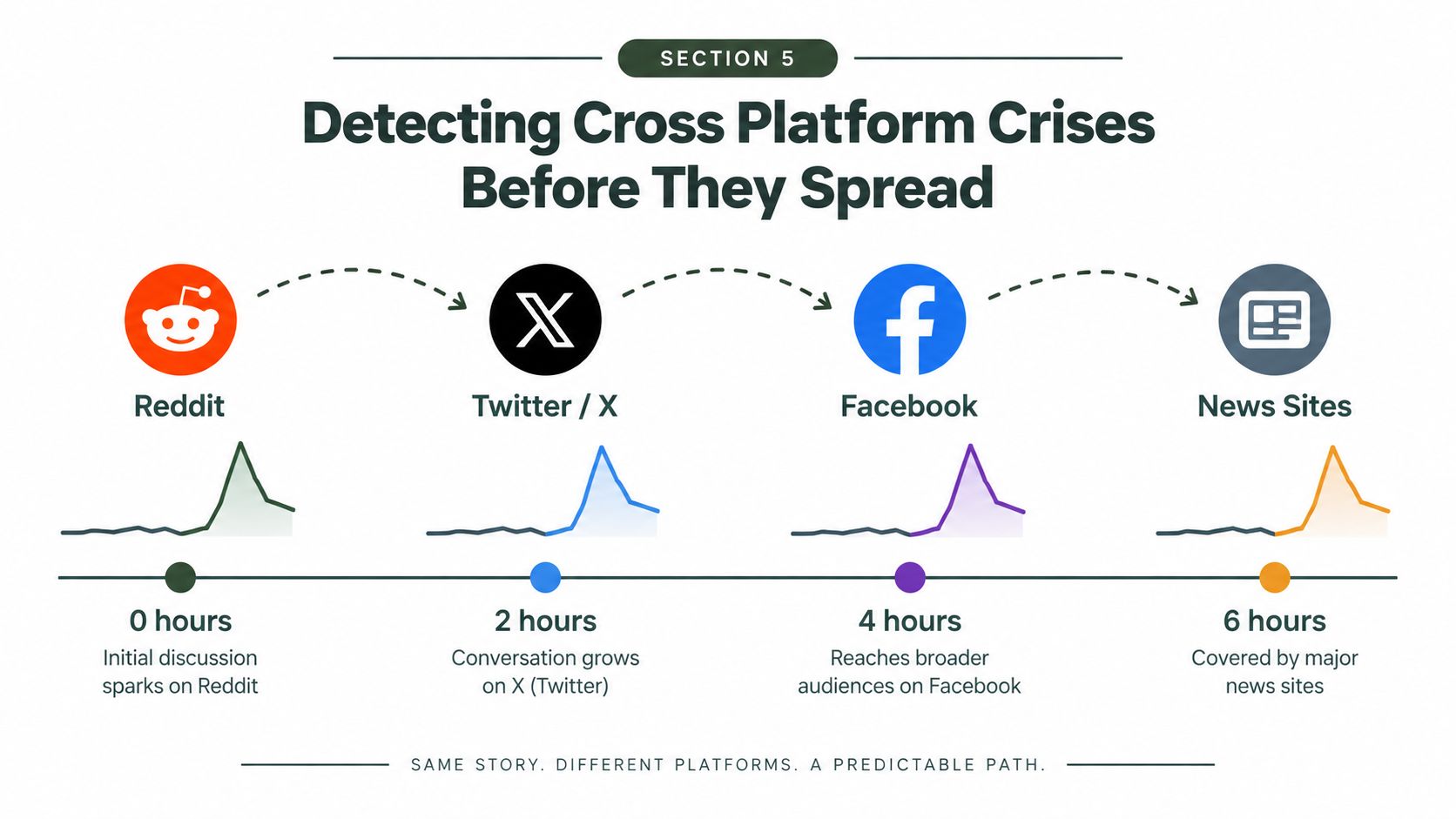
A single-platform spike is often the beginning of a wider event, not the whole event. The migration path can start with a Reddit thread, move to a high-follower X account through a screenshot, reach niche newsletters, and then attract mainstream coverage through a quote or image.
The important signal isn't volume alone. Teams should watch for synchronized hashtag adoption, screenshot velocity, quote-post acceleration, influencer pickup, and inbound journalist questions. A complaint that remains isolated is different from a narrative that appears independently across communities and carries the same language or evidence.
Replace channel silos with a narrative graph
Build a cross-platform keyword graph that connects:
- Brand and product names: Include misspellings, abbreviations, and common nicknames.
- Risk topics: Track terms tied to safety, privacy, discrimination, pricing, reliability, and conduct.
- Narrative fragments: Monitor distinctive phrases, screenshots, and repeated allegations.
- Source relationships: Record which accounts, communities, newsletters, and journalists are repeating the story.
Use velocity alerts rather than simple volume alerts. A sudden increase in repeated language across separate channels is more meaningful than a large number of unrelated comments. Also track the direction of travel. A conversation that moves from a niche community to an account with broad audience overlap requires earlier intervention.
The response template should be prepared before the event. It needs an owner, approved holding language, evidence requirements, escalation contacts, and channel-specific adaptations. One-step approval doesn't mean one-size-fits-all publishing. It means the authorized reviewer can approve a controlled first response without rebuilding the process under pressure.
Catching migration in the first two hours is difficult without automation, especially when a small team is covering multiple timezones and channels. Manual monitoring forces someone to inspect each network, identify duplicate narratives, judge reach, and notify the right owner. That work is slow precisely when the narrative is moving fastest.
Cross-platform detection is therefore a staffing decision. If the organization expects near-continuous coverage but can't staff every channel, it needs automated collection and ranking, with people reserved for judgment and escalation. A practical framework for sentiment analysis on social media can support that setup, provided sentiment is treated as one signal among reach, topic, and velocity.
How an AI Agent Compresses the Monitoring and Response Loop
An AI agent should not replace crisis judgment. It should remove the repetitive work that keeps skilled people from applying that judgment.
The operating loop has four stages:
- Continuous ingestion: Collect relevant mentions, comments, messages, reviews, and cross-channel signals.
- Severity ranking: Classify each item against brand-specific risk rules, audience relevance, reach, topic, and velocity.
- Draft generation: Produce a context-aware first response using approved brand guidance and prior approved responses.
- Approval and learning: Route the draft to the right human, record the decision, and use approved actions to improve future prioritization and reporting.
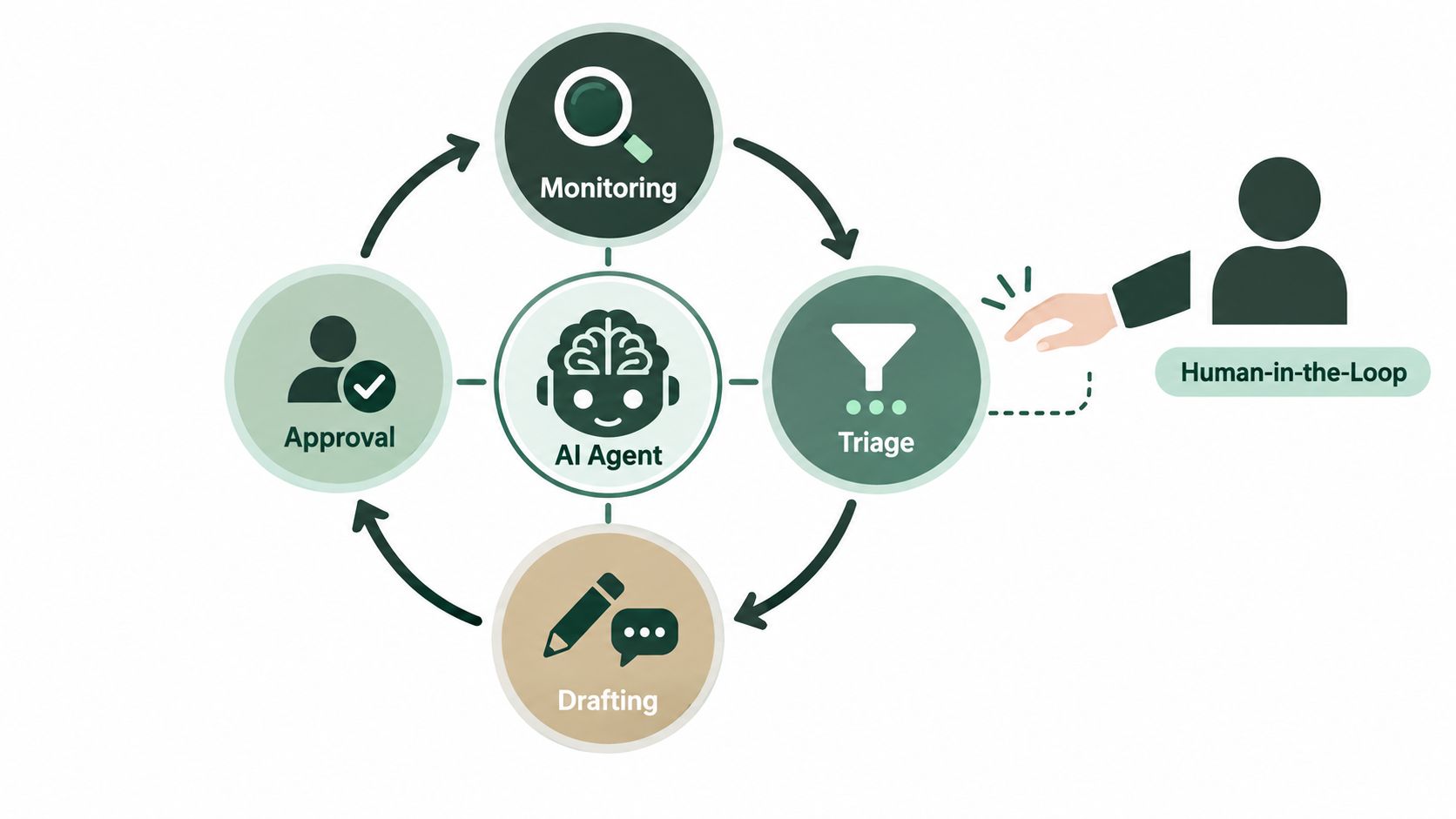
The value comes from volume handling, consistency, and coverage outside normal working hours. An agent can group duplicate mentions, surface a developing topic, prepare multiple channel-aware drafts, and show the reviewer what changed since the last check. It can also keep the queue moving while a human handles the most sensitive issue.
The guardrails are essential:
- Human approval gates: Nothing publishes until an authorized person approves it.
- Escalation rules: Legal, safety, executive, and crisis categories route to named owners.
- Audit trails: The system records the source mention, classification, draft, reviewer, and final action.
- Brand context controls: The agent uses approved guidelines rather than improvising policy.
- Channel awareness: A response should fit the network, audience, format, and public visibility.
Humans must retain judgment over legal exposure, executive communications, factual uncertainty, compensation decisions, and crisis leadership. The agent can prepare the case, identify related mentions, and suggest language. It shouldn't decide whether the company admits fault or makes a binding promise.
Crowbert provides an autonomous AI agent for end-to-end social work, including monitoring, triage, drafting, scheduling, engagement, analytics, and approval routing. Its architecture uses a dedicated client workspace, specialized agents for functions such as creative production, planning, analysis, and reporting, plus explicit human approval before publishing. The AI agent for social media model is most useful when the team already understands its risk categories and wants to reduce manual handoffs.
The right framing is force multiplication. Automation handles repetition. People handle accountability.
Putting It All Together and Answering Common Questions
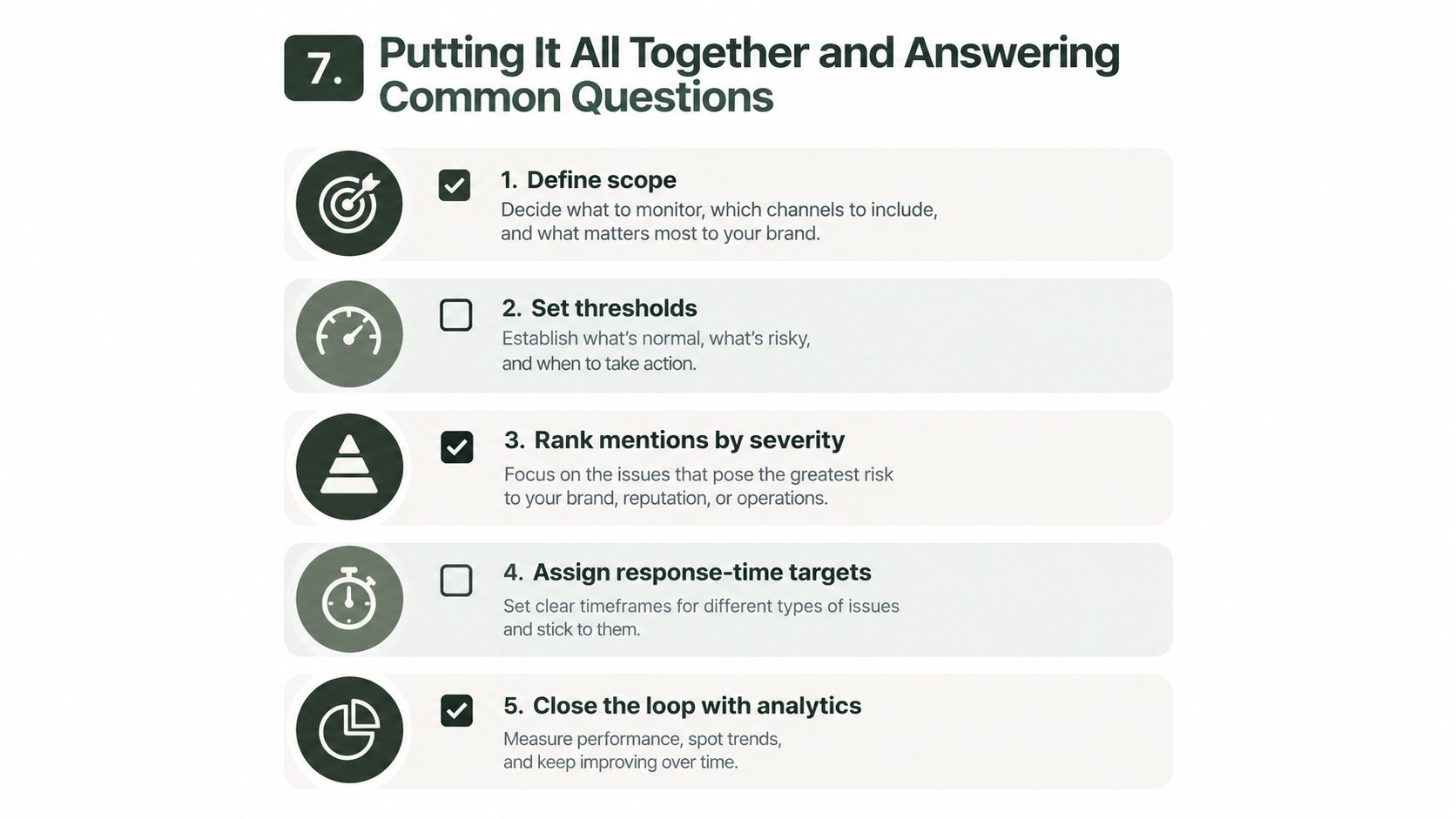
A workable social media reputation monitoring program has five operating commitments:
- Define scope: Track conversation that can affect trust, demand, stakeholders, or brand risk.
- Set thresholds: Establish a historical baseline before using velocity and anomaly alerts.
- Rank by severity: Combine risk, reach, audience overlap, topic relevance, and spread.
- Assign response targets: Separate first review, drafting, approval, and resolution.
- Close the loop: Send recurring issues to support, product, communications, legal, or leadership.
Is a free listening tool enough?
It can be enough for a small brand with limited channel volume, low reputational exposure, and someone available to check alerts consistently. It stops being enough when mentions cross platforms, the team needs historical baselines, or an alert must reach different owners according to risk.
How should a team evaluate dedicated monitoring software?
Start with workflow, not feature count. Ask whether the system supports historical collection, topic clustering, reach-aware prioritization, cross-channel detection, escalation, approval, auditability, and reporting. A tool that finds more mentions but leaves every response manual may increase workload rather than reduce it.
What staffing does an in-house program require?
Staffing depends on channel volume, risk, timezone coverage, and approval complexity. Define who reviews alerts, who drafts, who approves, who handles support handoffs, and who leads a crisis. If those roles aren't explicit, the program relies on goodwill and fails during absence or peak demand.
How should an agent-driven platform be compared with alternatives?
Test the complete loop. Give each option the same sample mentions and ask it to classify risk, identify duplicates, draft responses, route approvals, preserve an audit trail, and report unresolved issues. The winner is the platform that improves operational control without bypassing human accountability.
Crowbert can centralize social content creation, publishing, engagement, analytics, and agent-assisted workflows while keeping approval in human hands. Visit Crowbert to see how its autonomous AI agent can monitor conversation, rank actionable mentions, prepare responses, and coordinate approved social work end to end.
About the Author
The team behind Crowbert building AI-powered marketing tools that help businesses of all sizes create professional campaigns, manage social presence, and drive real results.