Social Media for Lead Generation: A Practical Playbook
Learn how to turn social media for lead generation into a measurable pipeline with channel-specific tactics, conversion paths, KPIs, and a rollout calendar.
Social media reached 5.42 billion active users worldwide in 2025, roughly 65% of the global population, and 68% of marketers say it helps generate leads. That scale and adoption change the question. Social media for lead generation isn't a posting exercise. It's a channel-mix and conversion system that turns attention into identifiable prospects, then gives sales a realistic path to revenue.
The strongest programs don't judge success by reach alone. They connect audience selection, content, native forms, landing pages, CRM attribution, and response speed. The sections below show how to build that system across B2B and B2C channels, avoid wasteful distribution, and run a practical 90-day rollout.
Table of Contents
What Social Lead Generation Means in 2026
Social lead generation starts when public attention becomes a trackable contact record. A prospect watches a video, responds to a message, submits a native form, or visits a campaign landing page. The funnel earns credit only when that action creates a CRM record containing the source, campaign, offer, and qualification data.
This definition keeps lead generation separate from adjacent work. Awareness builds familiarity. Community management answers questions and strengthens trust. Content marketing helps buyers understand a problem. Lead generation adds a measurable conversion event and a clear handoff to the next pipeline stage.
Social deserves its own acquisition plan. Current industry data reports that 20% of marketers rank social media as their number one lead source. Reach alone does not justify equal funding across networks. Each channel needs an owner, a defined role, and reporting that connects spend and effort to qualified outcomes.
The operating model
A practical funnel has five connected layers:
- Audience: Define the people and accounts that can buy, not those most likely to engage.
- Message: Match the problem, proof, and level of sophistication to the selected audience.
- Offer: Give visitors a specific reason to identify themselves now.
- Conversion: Choose the lowest-friction path that still gathers enough information for qualification.
- Measurement: Pass campaign and source data into the CRM, then report qualified outcomes instead of surface activity.
This model applies across organic posts, paid distribution, direct messages, native forms, and landing pages. Organic content can create demand and reveal which problems attract qualified attention. Paid campaigns can extend reach or capture existing intent, but they also expose weak offers quickly through wasted impressions and low-quality submissions. The conversion path determines whether that attention becomes usable pipeline.
The channel changes the mechanics. A professional buyer may respond to a focused point of view and a native form. A consumer buyer may need a short video, a direct message, and a simple appointment path. The system stays consistent, while the audience, creative, targeting, and conversion event change with the buying context.
Teams coordinating production, approval, publishing, and analysis can use this overview of AI social media management to structure repetitive work. Automation can handle scheduling and reporting, while people retain responsibility for claims, audience judgment, approvals, and follow-up quality. That division protects efficiency without treating software as a replacement for marketing decisions.
Choosing the Right Channels for Lead Quality
LinkedIn has the clearest historical advantage in B2B. One 2026 compilation reports that it drives roughly 80% of B2B social media leads, while 89% of B2B marketers use it for lead generation. The same compilation describes LinkedIn as 277% more effective for lead generation than Facebook or X, although that comparison shouldn't be read as a universal rule for every market.
Lead quality depends on buyer intent, offer fit, and the economics of the sale. LinkedIn often suits considered B2B purchases. Instagram and TikTok can be stronger for visual consumer offers, creator-led education, and local demand. YouTube gives buyers room to evaluate a complex problem, while X can work well when a narrow professional community gathers around a specific topic.
The table uses only verified benchmark figures where they exist. For other channels, CPL should be treated as an operating variable to establish through testing, not as a universal market fact.
Channel fit by use case
| Channel | Typical lead intent | Average CPL band (USD) | Best funnel stage | Strongest use case |
|---|---|---|---|---|
| Considered B2B purchase | Benchmark available, not universal | Awareness to demo | B2B SaaS demos and professional services | |
| Self-serve to moderately considered | Establish through testing | Discovery to nurture | Visual products, coaching, and creator-led offers | |
| TikTok | Self-serve or problem-aware | Establish through testing | Discovery to lead capture | Consumer education and short-form demonstrations |
| Self-serve to local service inquiry | Establish through testing | Capture and retargeting | Local services and broad consumer audiences | |
| YouTube | Considered purchase | Establish through testing | Education to evaluation | High-ticket products and complex solutions |
| X | Niche, authority-led intent | Establish through testing | Authority to conversation | Specialist B2B categories and communities |
A B2B SaaS company selling to a defined buying committee should usually begin with LinkedIn, then test YouTube if the product needs explanation. A high-ticket consumer coach may find better economics through Meta or TikTok, especially when testimonials, demonstrations, and creator-style content carry the argument. Ecommerce brands often need a different conversion event, such as an email or product education sequence, rather than a sales call.
B2B benchmark summaries place LinkedIn at roughly 75% to 85% of social-generated B2B leads, with one comparison citing a 2.74% visitor-to-lead conversion rate, compared with 0.77% for Facebook and 0.69% for Twitter/X. This guide to LinkedIn lead generation provides useful background on the platform's targeting and capture mechanics, but teams should still validate lead quality against opportunities, not submissions alone.
Review the Crowbert LinkedIn platform workflow when your team needs channel-specific formatting and approval across a broader publishing system. The point isn't to distribute identical posts everywhere. It's to preserve the strategic idea while adapting the execution to each network.
Audience Targeting That Reaches Real Buyers
Targeting fails when marketers define an audience by broad interest and stop there. Qualified lead generation needs several signals working together, with exclusions that prevent existing customers, employees, competitors, and unqualified segments from consuming budget.
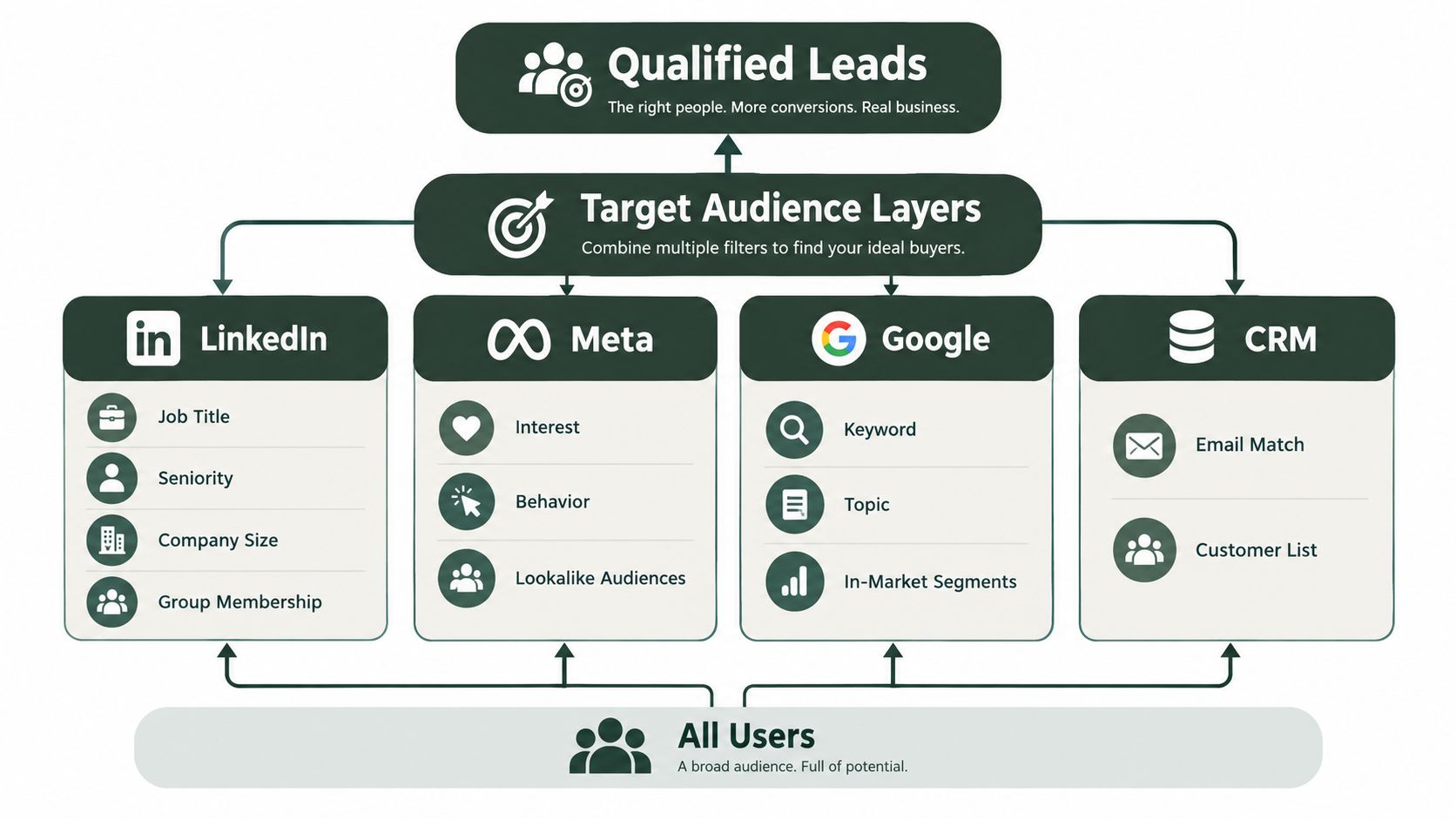
Layer signals by buyer profile
For a B2B offer aimed at a VP of Marketing at a 200 to 2,000-person software company, LinkedIn targeting can combine job title, seniority, company size, and group membership. Each layer removes noise. Job title alone often includes people who influence a purchase but can't approve it, while seniority alone can include executives outside the relevant function.
Meta works differently. Start with broad delivery where the system can learn, then provide refined seed audiences from qualified CRM records, high-value site actions, or engaged customer segments. Value-based lookalikes are more useful than lists built only from low-intent signups because they tell the system which outcomes matter.
TikTok can combine interest clusters with creator-aligned signals and Spark Ads audiences built from content that already attracts relevant engagement. This is particularly useful for a fitness buyer in a specific metro, where creative context and local relevance may matter more than a narrow demographic definition.
YouTube targeting can layer custom intent around search keywords with topic and in-market segments. This suits buyers who are already researching a problem. X can use follower lookalikes and engagement audiences to reach people who follow relevant accounts or interact with specialist conversations.
Protect the signal
Audience quality deteriorates when data sources are stale, consent is unclear, or exclusions are missing. Remove converted leads from acquisition campaigns, separate current customers from prospects, and pass qualified outcome data back into the ad system when the platform supports it.
Crowbert's audience targeting features can support campaign coordination across channels, but the strategic responsibility remains with the marketer. No automation layer can repair an unclear ideal customer profile or a weak definition of “qualified.”
Content Types and Hooks That Convert
Most lead-generation posts don't fail because the video is slightly less polished or the design uses the wrong layout. They fail because the audience can't tell what they'll receive, why it matters, or what to do next.
LinkedIn carousels work well when they compress one useful framework into a short sequence. Native form posts suit clear assets such as a diagnostic, benchmark worksheet, or event registration. On Instagram and TikTok, short-form video needs a visible takeaway, not just a product appearance. YouTube can bridge educational content to a checklist, calculator, or consultation because viewers have more time to evaluate the argument.
Match format to the offer
| Channel | Best format | Hook pattern | Top offer type |
|---|---|---|---|
| Framework carousel or native form post | Contrarian claim or mistake callout | Diagnostic or template | |
| Reel, story sequence, or DM trigger | Before and after | Quiz or consultation | |
| TikTok | Short demonstration or creator-led video | Specific problem and quick payoff | Checklist or guided next step |
| Native form, event post, or retargeting creative | Local problem or practical outcome | Appointment or downloadable guide | |
| YouTube | Short or long-form explanation | Search-led question | Calculator, checklist, or consultation |
| X | Focused thread | Evidence-led claim or niche observation | Email brief or community invite |
A useful hook makes the problem concrete. “Three signs your reporting process is wasting qualified demand” gives the viewer a reason to continue. “Improve your marketing today” doesn't. Other reliable patterns include a specific number when it can be supported, a counterintuitive claim, a before-and-after contrast, and a mistake that the audience can recognize immediately.
The offer should also match intent. A low-commitment visitor may exchange an email for a calculator. A buyer evaluating a complex service may accept a diagnostic session. A community or cohort invitation can work when the product benefits from shared learning and recurring participation.
Reach doesn't equal pipeline
Consider two posts. The first receives strong impressions because it makes a broad observation about growth, but its call to action says “learn more” and leads to a generic homepage. It generates no identifiable leads. The second reaches fewer people, names a specific operational problem, offers a ready-to-use template, and sends visitors to a matched form. It books 30 demos in the scenario because the offer and next step fit the audience.
That example is a planning model, not a reported case study. Its lesson is practical: don't optimize the creative separately from the conversion path. This guide to social media copywriting is relevant when the team needs to sharpen hooks, proof, and calls to action without turning every post into an advertisement.
Conversion Paths, Forms, and Follow-Up Speed
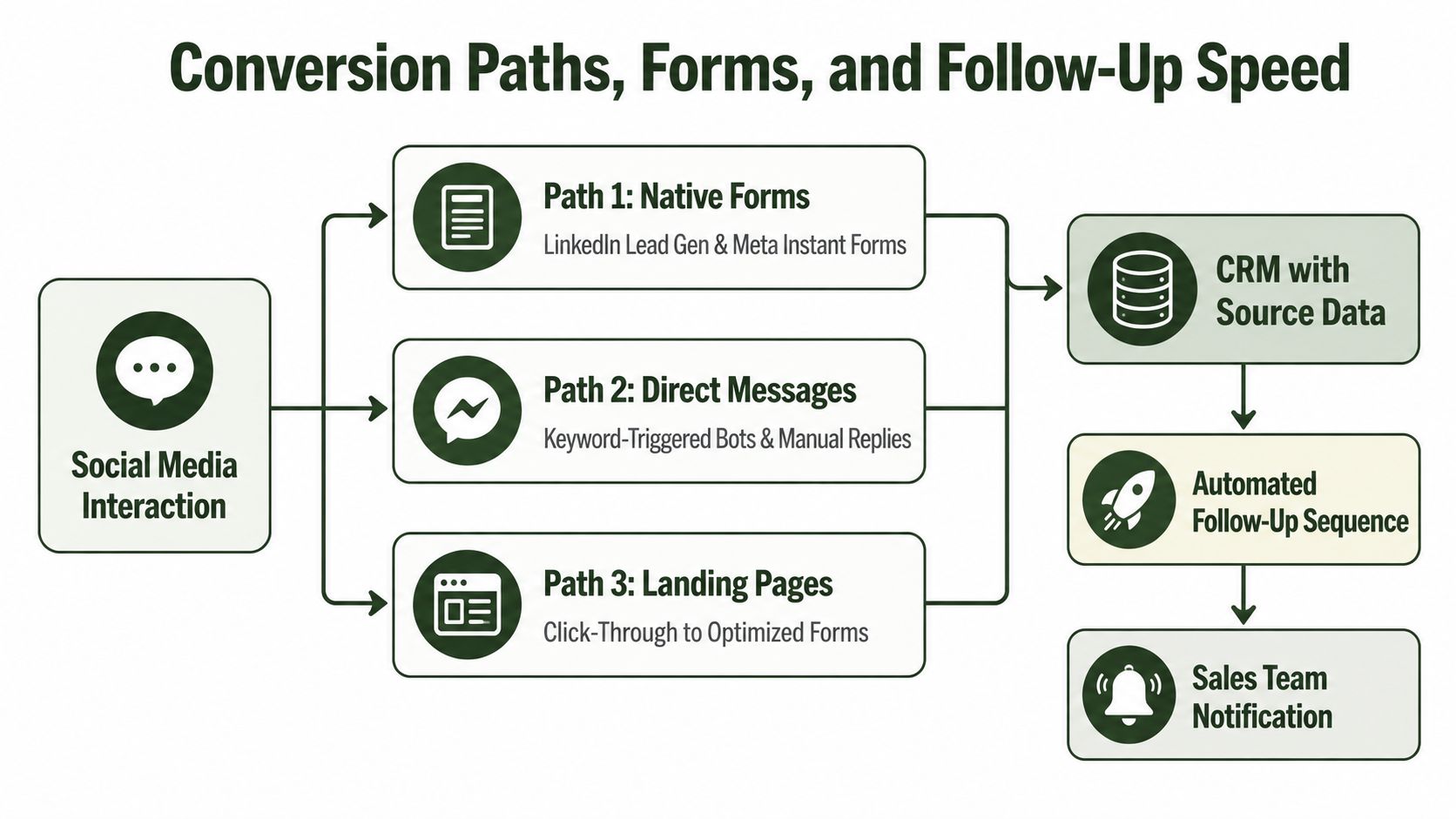
A lead isn't operationally useful until the CRM receives the contact with source data attached. The capture mechanism should match the ticket size, sales cycle, and amount of information needed to decide whether a human should follow up.
Native forms reduce the distance between interest and submission. LinkedIn Lead Gen Forms pre-fill user information, and one benchmark puts their average completion rate at 13%, compared with 4.02% for a typical landing page. The benchmark guide explains why the form mechanic deserves separate attention rather than being treated as just another ad destination.
Choose the path deliberately
- Native forms: Use them for content downloads, event registration, early qualification, and mobile-first campaigns. They reduce friction, but easy completion can also produce weaker intent.
- Direct messages: Use keyword-triggered replies or manual conversations when context matters. DMs work well for coaching, local services, and offers where a short exchange can qualify the buyer.
- Landing pages: Use them when the offer needs proof, pricing context, product detail, or a longer qualification sequence. The added friction can be justified for a considered purchase.
Keep the form short. A practical test is to reduce the fields from 7 to 3, pre-fill what the platform knows, add a one-line privacy reassurance, and replace a generic “book a call” button with an embedded calendar when the visitor has already shown high intent. Those are implementation recommendations, not guaranteed benchmark lifts.
Follow up while intent is active
Benchmark roundups report a median $178 cost per lead for paid social across Meta and LinkedIn, with lead-to-opportunity conversion around 4.1%. The underlying lead-generation data also reports performance gaps as large as 4.7x in B2B CPL, which is why cheap submissions can become expensive leakage when qualification and response are weak.
Leads contacted within 5 minutes convert at 3 to 10 times the rate of those contacted within an hour. This figure appears in the prescribed operating model, but it isn't included in the verified source list, so treat it as a response-speed principle rather than a universal benchmark. Route every submission to the CRM immediately, trigger a Slack or equivalent internal alert, and assign ownership.
A simple three-touch sequence works better when it reflects the source. The first message confirms the requested asset or action. The second answers a likely problem associated with that offer. The third asks a direct qualification question or offers a relevant next step. Don't send the same generic autoresponder to someone who requested a pricing conversation and someone who downloaded an introductory checklist.
The embedded walkthrough below can help teams visualize the relationship between interaction, capture, CRM routing, and follow-up.
KPIs and Measurement That Drive Decisions
A social funnel needs a KPI tree, not a dashboard full of disconnected numbers. Start with delivery, move through response and capture, then end with qualification and commercial progress:
Reach and impressions → engagement → click or conversation → form completion → accepted lead → qualified opportunity → revenue.
Each stage answers a different diagnostic question. Low engagement usually points to audience or creative relevance. Strong clicks with weak submissions indicate an offer or form problem. Plenty of leads with few opportunities indicates poor targeting, weak qualification, or slow follow-up.
Use verified benchmarks carefully
The available benchmark data is uneven. Some figures describe a specific comparison set or a benchmark roundup, not a universal standard for every industry.
| Channel | Form completion rate | Blended CPL (USD) | Lead-to-opportunity % |
|---|---|---|---|
| LinkedIn native form | 13% benchmark | Included in paid-social median where applicable | Included in paid-social benchmark where applicable |
| Typical landing page | 4.02% benchmark | Varies by campaign | Varies by campaign |
| Paid social, Meta and LinkedIn | Not specified as a combined form rate | $178 median benchmark | 4.1% benchmark |
| Facebook comparison set | Not specified as a form rate | Establish from account data | 0.77% visitor-to-lead comparison |
| Twitter/X comparison set | Not specified as a form rate | Establish from account data | 0.69% visitor-to-lead comparison |
The comparison figures for Facebook and X describe visitor-to-lead conversion, not lead-to-opportunity conversion. Keep those definitions separate in reporting. Crescade's discussion of 2026 social media strategy can provide additional planning context, but it shouldn't replace your own CRM-based measurement.
Report decisions, not activity
Ignore raw likes, follower growth, and view counts unless they lead to an observable downstream action. A large audience can be commercially irrelevant if it doesn't contain buyers or if the content never presents a useful next step.
Use consistent UTM parameters, preserve platform campaign IDs, and connect conversion data through the relevant server-side or CRM integrations where available. Review performance by cost per qualified lead, lead-to-opportunity rate, response time, and source-assisted revenue. A creative problem has weak engagement. An offer problem has clicks without submissions. A targeting problem has submissions without qualification.
A one-screen weekly report should include spend, reach, clicks, submissions, qualified leads, opportunities, CPL, cost per qualified lead, lead-to-opportunity rate, response SLA, and the single action for the following week. This guide to measuring social media success is useful for turning those figures into a repeatable review process.
A 90-Day Rollout Calendar and Common Questions
A 90-day launch should produce learning before it produces scale. The first phase establishes the ICP and data path. The second creates enough content and paid testing to find useful baselines. The final phase improves offer economics, qualification, and follow-up.
The working calendar
| Week | Phase | Primary activities | Channels | Deliverable |
|---|---|---|---|---|
| 1 | Foundation | Validate ICP, buying triggers, exclusions, and conversion event | Priority channel plus CRM | ICP and measurement brief |
| 2 | Foundation | Wire pixels, UTMs, forms, CRM routing, alerts, and ownership | Paid and organic sources | Tested lead path |
| 3 | Launch | Publish authority content and first offer-led posts | Priority organic channel | Content pillars live |
| 4 | Launch | Start one paid test with controlled creative and audience variables | Priority paid channel | Initial CPL baseline |
| 5 | Learning | Review engagement, clicks, submissions, and lead quality | Organic and paid | First diagnostic report |
| 6 | Learning | Test a second format or offer without changing every variable | Priority channels | Offer comparison |
| 7 | Optimization | Select the strongest two offers by qualified outcome | Best-performing channels | Offer shortlist |
| 8 | Optimization | Tighten form fields, qualification questions, and routing | Capture and CRM | Revised conversion path |
| 9 | Optimization | Refresh retargeting audiences and follow-up messages | Paid and CRM | Retargeting update |
| 10 | Optimization | Improve response SLA and source-specific nurture | CRM and sales | Handoff audit |
| 11 | Economics | Review cost per qualified lead and opportunity progression | All active channels | Funnel economics review |
| 12 | Planning | Lock next-quarter budget, exclusions, cadence, and tests | Selected mix | Approved growth plan |
A workable weekly cadence includes scheduled authority content, offer-led posts, dedicated DM response windows, a retargeting refresh, and a single reporting review. Don't confuse frequency with consistency. A small team can generate leads with modest time investment. One benchmark summary reports that 66% of marketers generated leads from social media while spending 6 hours per week, although the outcome still depends on relevance and follow-up. The benchmark source supports the broader point that disciplined execution can matter more than sheer publishing volume.
The content-to-offer mix should follow the funnel. Discovery content earns attention with a problem or point of view. Consideration content demonstrates a framework, result, or process. Conversion content presents a diagnostic, template, calculator, or direct consultation. Retargeting should answer objections rather than repeat the introductory message.
Frequently Asked Questions
Should paid and organic social receive the same budget?
No. Organic work builds authority, supplies creative learning, and supports retargeting. Paid spend should follow the channels and offers that produce qualified outcomes, not be divided evenly for the sake of fairness. One 2026 roundup reports that 51% of businesses use paid social as a top lead-generation channel, and 73% of B2B marketers using paid channels use social advertising or promoted posts. Those figures support a blended model, not an automatic commitment to every platform.
When should a team use native lead forms instead of landing pages?
Use native forms when mobile friction is the main barrier and the offer is easy to understand. Use a landing page when buyers need proof, pricing context, product detail, or a more deliberate qualification step. Native forms can increase completion, but the CRM still needs to distinguish convenient submissions from genuine buying intent.
Is LinkedIn advertising better than LinkedIn organic content?
They solve different problems. Organic content develops authority and reveals which messages earn meaningful engagement. Paid distribution expands reach among selected accounts and can attach a form or focused landing page. Test both against qualified opportunities, not impressions or clicks alone.
What counts as a realistic cost per lead?
There isn't one universal CPL. A paid-social median of $178 and lead-to-opportunity conversion around 4.1% provide a benchmark for a specific Meta and LinkedIn comparison set, not a promise for your market. Calculate your own acceptable CPL from average contract value, close rate, sales capacity, and the cost of follow-up.
What should a team do with low-quality submissions?
Add one or two high-signal qualification fields, tighten exclusions, revise the offer, and send qualified outcome data back into the advertising workflow where possible. Don't solve a quality problem by increasing spend or discarding every lead from that channel.
How quickly should sales receive a social lead?
Immediately. The CRM should create the record, preserve source data, notify the owner, and trigger a source-specific first touch without a manual export. Fast routing protects the intent that existed when the prospect completed the form.
Crowbert provides an autonomous AI agent that can coordinate social content creation, channel-aware formatting, scheduling, publishing, engagement workflows, and performance reporting while keeping human approval in control. Visit Crowbert to see how its end-to-end workflow can support a measured social lead-generation program across organic and paid campaigns.
About the Author
The team behind Crowbert building AI-powered marketing tools that help businesses of all sizes create professional campaigns, manage social presence, and drive real results.


