Video Time YouTube Explained and How to Grow Watch Time
Learn what video time YouTube means, how watch time drives ranking, ideal lengths by format, and how to boost retention for growth.
A channel can attract plenty of clicks and still fail to build meaningful momentum. A creator might see a healthy view count, then discover that viewers leave early, total watch time remains weak, and the video stops appearing in recommendations. That's why video time on YouTube is more useful than views alone when you're deciding whether a piece of content worked.
YouTube operates at extraordinary scale. Industry summaries report that people worldwide watch over 1 billion hours of YouTube video every day, with one estimate placing global daily viewing at approximately 2.43 billion hours. Another summary reports that YouTube has crossed 2.7 billion monthly users. U.S. viewers also watch more than 200 million hours per day on connected TVs, showing how YouTube has become a lean-back viewing habit as well as a mobile platform. These figures are reported in YouTube platform data for 2026.
The practical question isn't “How long should every video be?” It's “How do I turn discovery into sustained attention?” This guide explains what watch time, average view duration, and audience retention mean, how to read them, how to choose length by content type, and how to build a funnel in which short content introduces your channel while longer content earns deeper viewing. For a broader framework around measuring outcomes, see how to measure social media success.
Table of Contents
Introduction Why Video Time Matters More Than Views
Consider two uploads from the same channel. The first receives many clicks because its title and thumbnail create immediate curiosity. Viewers leave after the opening explanation, though, so the video accumulates little meaningful viewing. The second attracts fewer initial clicks, but viewers stay through most of the presentation and continue to another related video.
The first upload may look stronger in a basic view report. The second gives YouTube better evidence that viewers found the experience satisfying. A view starts the journey, but watch time shows how far viewers traveled.
The difference between attention and traffic
A view is a useful entry signal, but it doesn't tell you whether someone watched a few seconds or stayed for the central idea. Watch time adds that missing context by measuring the minutes viewers collectively spend with the video. Audience retention adds even more detail, showing where attention rises, falls, or disappears.
That distinction matters across every discovery surface. Search can bring a viewer to your video, Home can introduce it to a broader audience, and Suggested can place it beside related content. Strong packaging may earn the click, but the opening, pacing, clarity, and payoff determine whether the viewer keeps watching.
A better way to judge a result
Don't treat low retention as proof that the entire concept failed. First separate the two possible problems:
- Packaging problem: The title or thumbnail didn't attract the right viewer, so the click-through opportunity was weak.
- Experience problem: The packaging worked, but the opening or structure didn't hold attention.
- Expectation problem: The video delivered something different from what the title and thumbnail suggested.
- Length problem: The topic ended early, or the edit added material that viewers didn't need.
This diagnosis prevents a common mistake. Creators often make a weak video longer because they believe more minutes must be better. In practice, a concise video that fulfills its promise can create more total viewing than a padded version.
The phrase video time YouTube points to a measurement problem, not a magic duration. Once you can read the difference between a click, a minute watched, and a viewer retained, you can make better decisions about format, editing, and the relationship between Shorts and long-form content.
What Video Time Means on YouTube
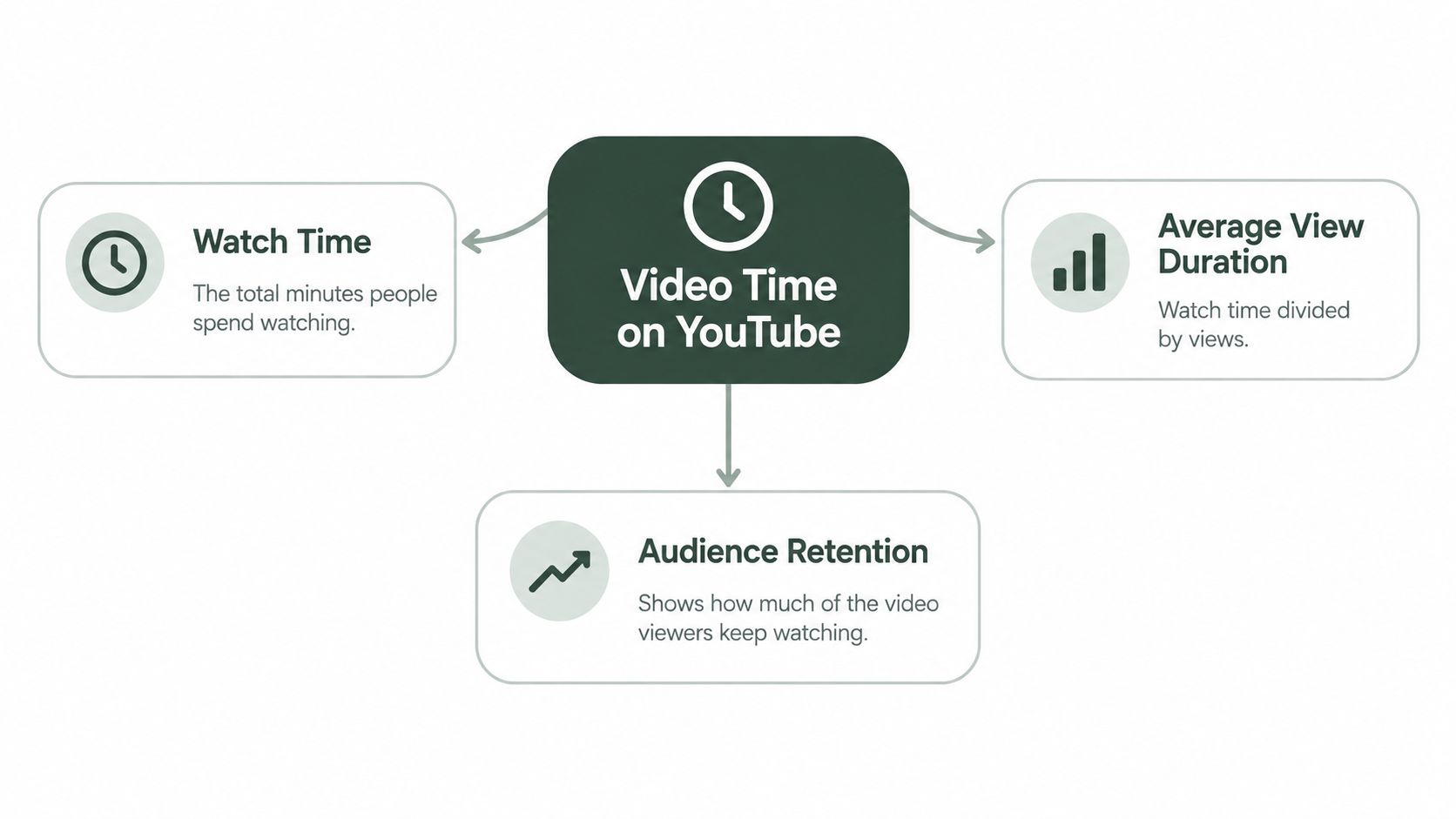
Start with the broadest measure: watch time. It represents the total amount of time viewers spend watching your videos. If many viewers watch a small portion, the view count may rise while the accumulated minutes remain modest. If viewers stay for substantial portions, the same number of views can produce a much stronger watch-time result.
Average view duration gives you a per-view perspective. It is the average amount of time watched for each view, which helps you compare videos that received different levels of traffic. A video with fewer views can still have a higher average view duration if the audience stays longer.
Audience retention shows the viewing pattern across the timeline. Rather than offering one overall number, the retention curve helps you identify the opening drop, moments that hold attention, sections that cause exits, and points where viewers rewatch or return.
A simple store analogy
Think of a video as a store. A view means someone walked through the door. Watch time is the total time all visitors spent inside. Average view duration is the typical length of one visit. Audience retention is a map showing which aisles attracted attention and where visitors walked out.
The analogy also clarifies why one metric can't answer every question. A high number of visitors with brief visits suggests strong visibility but weak engagement. A smaller stream of visitors who explore thoroughly suggests that the content is connecting with a more qualified audience.
How to read the report
Open the video in YouTube Studio and review its analytics rather than relying on the headline view number. Look at the total watch time, average view duration, and retention curve together. Then ask:
- Did enough people click to give the video a fair discovery opportunity?
- Where does the retention curve fall sharply?
- Does the biggest drop happen before the video reaches its promised value?
- Do viewers remain engaged after the introduction?
- Does the ending lead naturally to another useful video?
YouTube's audience retention report is available only for videos that are at least 60 seconds long and have at least 100 views. Videos below that threshold can't be benchmarked with the same key-moment retention tooling. YouTube Studio also allows creators to compare a video with other YouTube videos of similar length, so length normalization forms part of the analysis workflow. These reporting conditions are documented in YouTube's audience retention guidance.
That comparison matters because a short tutorial and a long interview create different viewing expectations. Compare like with like where possible, then use the curve to improve the next edit instead of chasing a universal benchmark.
How Watch Time and Retention Influence Ranking and Recommendations
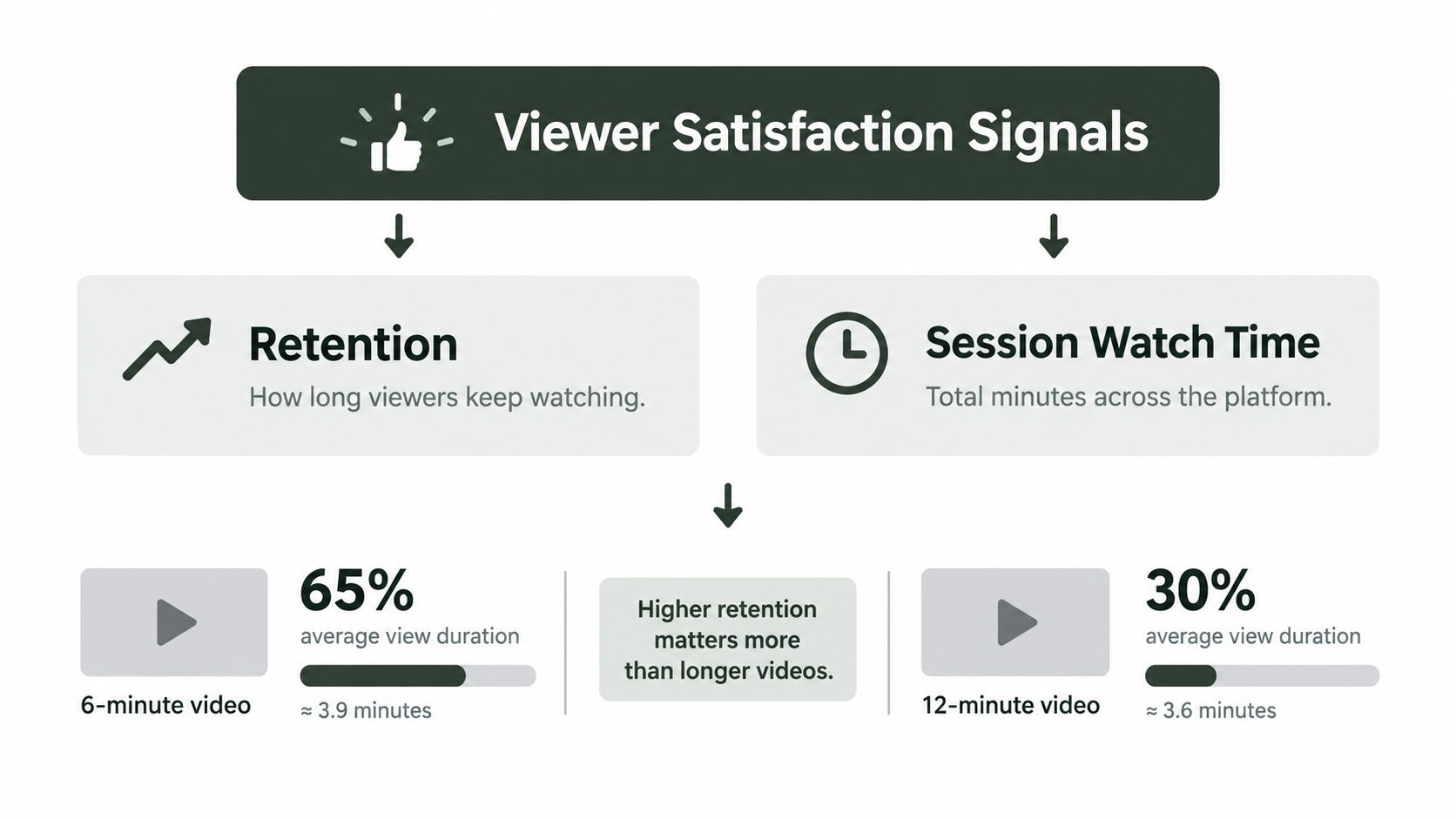
YouTube doesn't need a preferred video duration to evaluate whether a viewer had a good experience. It can assess signals connected to satisfaction, including whether people continue watching, whether they respond positively, and whether the viewing session remains useful.
That changes how you should think about ranking. A longer upload has more available minutes, but it doesn't automatically earn more actual minutes. If viewers leave early because the creator repeats points or delays the answer, the additional runtime creates no advantage.
Diagnose the failure before changing the length
A useful diagnosis separates click acquisition from viewer satisfaction.
If people don't click, examine the topic, title, thumbnail, and audience fit. If they click and leave immediately, examine the first promise and the first explanation. If they stay through the opening but exit during a particular segment, examine that segment's pacing, relevance, and clarity.
A short video can also support a longer session when it sends viewers to a closely related upload. This is different from stretching one video to fill time. The creator gives the viewer a complete answer, then offers a logical next step.
Why raw views are becoming less useful
Cross-format comparisons become harder when a view count doesn't represent the same depth of attention. Reporting on YouTube's August 2026 change says a view counts as soon as playback starts, which makes watch time even more important when you compare Shorts with long-form content. The metric change is discussed in reporting on YouTube's view metric and engaged views.
A 2025 to 2026 analysis cited in independent coverage found that long-form views rose about 76%, while total minutes watched rose about 11%. Average view duration fell roughly 37%, from 3.98 minutes to 2.51 minutes. Those figures illustrate why format growth and attention quality aren't the same thing. The analysis appears in coverage of how long a YouTube video should be.
The strategic lesson is straightforward. Don't ask whether a video is long enough in the abstract. Ask whether the current structure earns enough attention to justify its runtime, and whether the viewer has a satisfying reason to continue watching elsewhere on your channel. For a wider reporting workflow, use performance reporting guidance.
How Long Should Your YouTube Video Be by Content Type
There isn't one correct duration for every subject. A screen tutorial may need enough time to demonstrate a process, while a simple update may lose momentum if it includes background the audience already understands. Choose the runtime after defining the viewer's task and the minimum explanation required to complete it.
Match the format to the job
Use Shorts when discovery, a quick demonstration, a strong opinion, or one focused takeaway is the primary job. Use long-form when the viewer needs context, a sequence of steps, a detailed comparison, or a complete lesson. A channel can use both without treating them as disconnected strategies.
YouTube Shorts can now be up to 3 minutes long. The limit applies to square or vertical videos uploaded on or after October 15, 2024, and eligible uploads can use Shorts revenue sharing when they meet the format rules, as explained in YouTube's Shorts length guidance.
For planning purposes, think in ranges rather than rigid targets:
- Quick answer: Keep the video as short as the answer allows. Remove introductions that don't help the viewer.
- Tutorial: Use the time needed to demonstrate each essential step, then cut repeated explanations.
- Review: Give each evaluation criterion enough evidence to support a decision. A shorter review with clear proof is stronger than a longer one with general praise.
- Vlog: Let the day or story provide structure. Select scenes that move the narrative or reveal something useful.
- Commentary: Establish the central view early, then use examples and counterpoints to develop it.
- Education: Organize the lesson into clear units. If a topic contains several independent questions, consider separate videos rather than one overloaded upload.
For creators who need help finding viable story angles, this guide to vlog ideas for creators can support the planning stage without dictating the final runtime.
Platform facts that affect planning
| Metric | Value | Implication for Length Strategy |
|---|---|---|
| Global daily YouTube viewing | Over 1 billion hours | Even small improvements in sustained attention operate inside a very large viewing environment. |
| Estimated global daily viewing | Approximately 2.43 billion hours | Design for accumulated minutes, not only initial clicks. |
| Reported monthly users | Over 2.7 billion | A focused topic can serve a broad potential audience, but relevance still determines retention. |
| U.S. connected-TV viewing | Over 200 million hours per day | Clear audio, readable visuals, and relaxed pacing matter for lean-back viewing. |
| Shorts maximum duration | Up to 3 minutes | Use short-form for compact discovery and focused ideas. |
The platform's upload limits also matter operationally. The default maximum upload length is 15 minutes. Verified accounts can upload longer videos, while the maximum file size is 256 GB or 12 hours, whichever is less, according to the upload limits summarized in YouTube upload length guidance.
For teams building automated workflows, the YouTube Data API exposes duration through contentDetails.duration as an ISO 8601 value, such as PT15M33S for a video lasting 15 minutes and 33 seconds. That consistent format supports scheduling, classification, and analytics pipelines, as documented in the YouTube Data API video resource reference.
If your strategy spans several short-form channels, the same principle applies. Compare the viewer's task and expected attention before selecting a duration, as discussed in this guide to how long a TikTok video should be.
Proven Ways to Increase Watch Time and Audience Retention
Retention improves when the viewer understands the value quickly and receives that value without friction. The editing process should remove delays, not add runtime. A strong video feels complete because each section earns its place.
Build the opening around the promised outcome
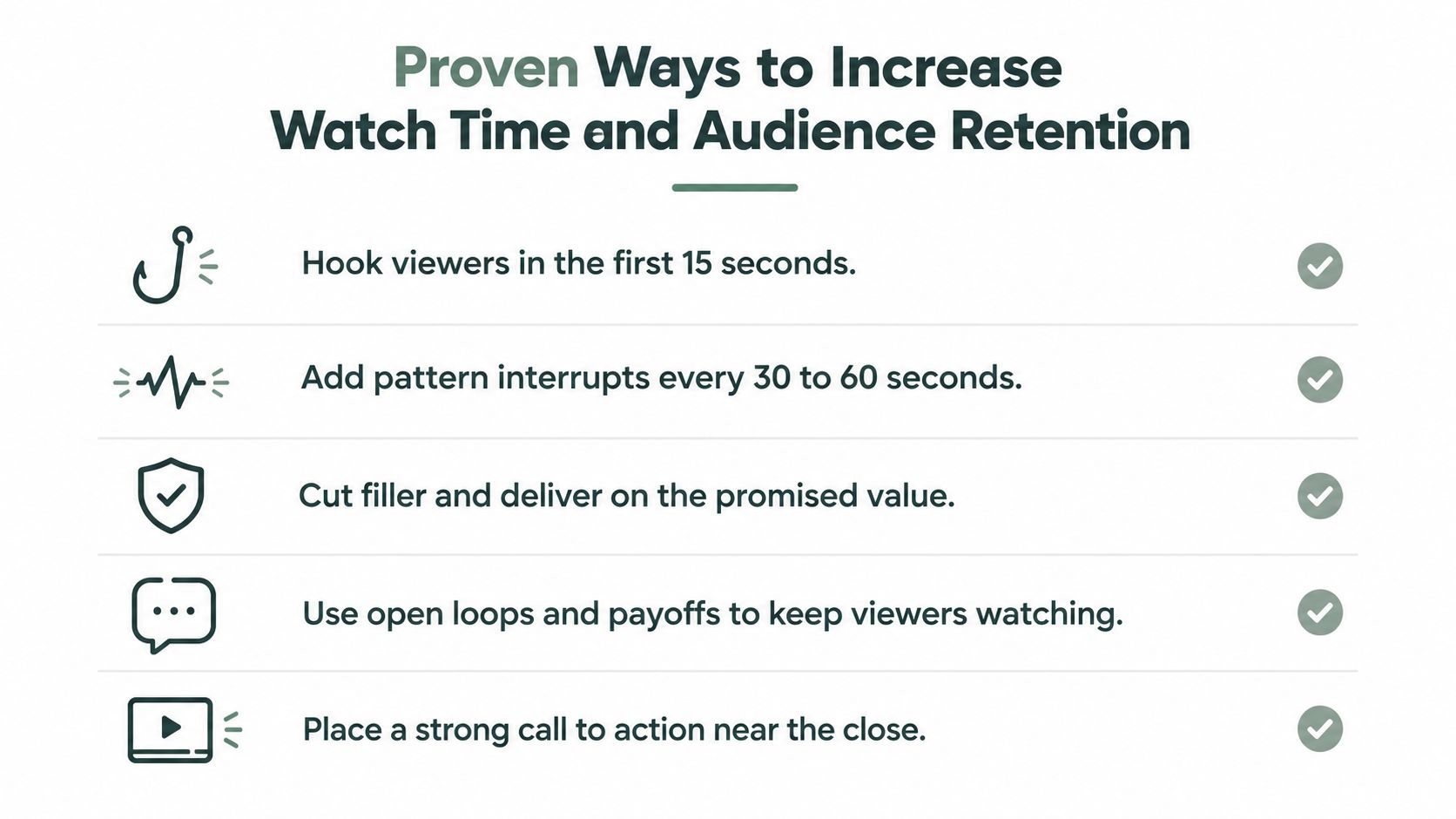
The first 15 seconds should make the viewer confident that they chose the right video. State the problem, show the result, or present the most relevant tension. Don't spend the opening on a long branded introduction if it delays the answer.
Then create movement through the middle:
- Use pattern changes: Shift the visual, example, framing, or rhythm when the explanation starts to feel predictable.
- Cut repeated material: If two sentences perform the same job, keep the clearer one.
- Create open loops: Introduce a question or unresolved point, then pay it off later.
- Use chapters thoughtfully: Give viewers a clear map for longer lessons without making every segment feel isolated.
- Protect the close: Offer a relevant next video or action after the core promise has been fulfilled.
The retention curve tells you where to investigate. A sharp early fall suggests a mismatch between packaging and opening. A gradual decline may point to pacing. A sudden drop in the middle often identifies a section that needs a tighter edit, clearer example, or stronger transition.
Run a practical edit review
Before publishing, watch the video once as a new viewer rather than as the person who made it. Mark every moment where the explanation repeats itself, the visual stops adding information, or the next useful point is obvious but delayed.
A concise six-minute video can outperform a loose twelve-minute video on total watch time if viewers remain engaged. That isn't a duration promise. It's a reminder to calculate the likely minutes earned by the finished experience, not the minutes available in the timeline.
Use a repeatable checklist:
- Does the title promise exactly what the opening begins to deliver?
- Can the viewer identify the outcome without waiting through setup?
- Does each section add a new piece of information?
- Are examples concrete enough to prevent confusion?
- Does the final recommendation lead to a related viewing path?
Creators who also publish across channels can use Crowbert's short video creation workflow when adapting a long explanation into a focused discovery clip. The important editorial step remains human judgment. A cut should preserve the original promise, not merely remove random seconds.
Using Crowbert to Optimize Video Length and Edits for Performance
A video-time strategy becomes difficult when ideation, editing, approvals, publishing, and measurement live in separate workflows. The practical solution is a connected process: define the viewer's job, create the long-form asset, extract discovery clips, review the edits, publish on schedule, and inspect retention before planning the next iteration.

Crowbert functions as an autonomous AI agent for social media work, with human approval before publishing. Its Creative Studio can support on-brand image, short-video, and copy production, while the producer workflow can help prepare channel-aware versions of a core idea. That makes it possible to treat a Short as a discovery asset connected to a deeper YouTube video rather than as an isolated post.
Connect discovery clips to deeper viewing
The format shift creates a clear funnel opportunity. Reporting using Tubular data says over 75% of YouTube views in 2025 came from Shorts, while videos longer than 20 minutes delivered over 57% of total minutes watched through May 2025. Those figures point in different directions, and that contradiction is useful. Shorts can provide reach, while longer videos can capture more accumulated minutes when viewers choose to stay. The figures are reported in coverage of YouTube's format and view-metric changes.
A connected workflow can turn one subject into several deliberate assets:
- A Short presents the problem or a compelling result.
- The long-form video explains the process in full.
- A follow-up clip answers an objection or highlights a practical step.
- The approval queue lets a person check accuracy, tone, and claims before anything goes live.
For teams evaluating production support, a directory of video production companies can help with projects that require capabilities beyond an internal workflow.
Measure the edit, then improve the next brief
Crowbert's performance analyst feature can fit into a review cycle in which published results inform future briefs. The agent doesn't replace editorial judgment. It helps centralize snapshots, identify patterns worth examining, and turn approved decisions into repeatable production tasks.
The useful output isn't a generic instruction to make videos longer. It's a clearer production decision: shorten the opening, remove a repeated section, create a related Short, or direct viewers toward a complete next lesson. That keeps watch time optimization tied to actual viewer behavior rather than assumptions about an ideal duration.
Frequently Asked Questions About Video Time on YouTube
Do longer videos rank better on YouTube?
No. YouTube doesn't require a preferred duration. A longer video can earn more total minutes when viewers stay engaged, but padding can reduce average view duration and retention. Choose the shortest length that delivers the promised answer thoroughly.
Should I focus on Shorts or long-form videos?
Use both when they serve different funnel jobs. Shorts can support discovery, while long-form can capture deeper viewing. Connect them through a shared topic, a clear next step, and a related viewing path instead of publishing unrelated clips.
What should I do when retention drops in the middle?
Locate the exact segment, then inspect what changed. Look for repetition, a weak transition, an unclear example, or a delay before the next useful point. Test a tighter edit, stronger visual support, or a clearer structure in the next version.
How can a new channel benchmark performance with limited data?
Start with your own baseline and compare videos with similar subjects and lengths. Track views alongside watch time, average view duration, and the retention curve. A small channel can still learn from where viewers stay and leave, even before it has a large comparison set.
Is a view count enough to compare Shorts and long-form?
No. View definitions and viewing behavior differ across formats. Use watch time and retention to understand the depth of attention, then judge each format against its role in the funnel.
Crowbert helps creators and teams plan, produce, approve, schedule, and analyze channel-aware social content through an autonomous AI agent with human approval at the publishing step. Visit Crowbert to connect discovery clips with deeper video content and build a more disciplined watch-time workflow.
About the Author
The team behind Crowbert building AI-powered marketing tools that help businesses of all sizes create professional campaigns, manage social presence, and drive real results.


